
M. Aurelius Antoninus
Dynasty: Severans
Augustus (AD 211-217)Caracalla was the son of the Emperor Septimius Severus. His real name was Marcus Antoninius (his father having adopted him into the Antonine dynasty) but he was given the name Caracalla because of the short Gallic cloak he frequently wore (Dio 29.3.3). Severus' plans for succession included Caracalla and his younger brother Geta to reign jointly, despite their mutual loathing for each other. The joint rule did not long outlive Severus (who died in AD 211) because Caracalla murdered his brother in AD 212, some say in their mother's own arms (Dio 78.2). Still extant today in Rome are the splendid Baths of Carcalla began in AD 211 by this emperor (HA, ‘Carcalla’ 9.1). Carcalla issued an edict in AD 212 that made all free men within the Roman Empire roman citizens, known as the ‘Constitutio Antoniniana’ (though Dio says this was to increase his tax base, Dio 78.9.5-6). Carcalla also issued a new denomination, a double denarius (known to modern collectors as the Antoninianus) although it only had a little over 1.5 times the silver. Towards the end of his reign, Caracalla wished to join the Roman and Parthian empires together and requested the daughter of Artabanus IV (the Parthian King) in marriage (Dio 79.1.1; Herodian 4.10). When this offer was politely avoided, Caracalla marched to invade Parthia. Initially he proved quite successful, but he was murdered on the connivance of his Praetorian Prefect Macrinus. Macrinus secured the help of a centurion Martialis, whose brother had been executed by the emperor. Whilst in the East Carcalla went to a visit a shrine of the Moon near Carrhae with a small retinue. En route, according to Herodian, he suffered a stomach upset and went off to relieve himself – “everyone turned their faces away and walked off as far as they could out of respect for the emperor’s dignity and his modesty while in the act. Martialis was watching … [and] ran toward him … stood over Antoninus [Caracalla] while he was pulling down his clothes from his waist and stabbed him.” (Herodian 4.13.4-5)
For explanations of many of the abbreviations used in Roman imperial obverse legends, click here.
|
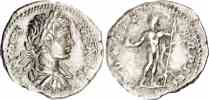
Caracalla Silver denarius issued AD 200 Obv: ANTONINVS AVGVSTVS, Laureate, draped, cuirassed bust right Rev: PONTIF TRP III, Sol standing left, holding globe in extended hand and spear
Nice Very Fine
|
AUD $160.00
|
|
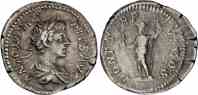
Caracalla Silver denarius issued AD 203 Obv: ANTONINVS PIVS AVG, Laureate, draped bust right Rev: PONT TRP VI COS, Roma standing left holding Victory and spear
Nice Very Fine
|
AUD $130.00
|
|
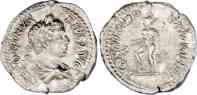
Caracalla Silver denarius issued AD 205 Obv: ANTONINVS PIVS AVG, Laureate, draped bust right Rev: PONTIF TRP VIII COS II, Mars standing left, foot set on helmet, holding branch and spear
Good Very Fine
|
AUD $170.00
|
|
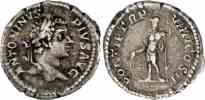
Caracalla Silver denarius issued AD 205 Obv: ANTONINVS PIVS AVG, Laureate, draped bust right Rev: PONTIF TRP VIII COS II, Mars standing left, resting on shield and holding spear
Nice Very Fine
|
AUD $150.00
|
|
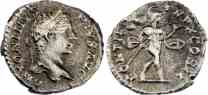
Caracalla Silver denarius issued AD 207 Obv: ANTONINVS PIVS AVG, Laureate head right Rev: PONTIF TRP X COS II, Mars advancing right, holding transverse spear and trophy over left shoulder
About Very Fine
|
AUD $130.00
|
|
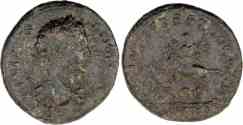
Caracalla Bronze as issued AD 208 Obv: ANTONINVS PIVS AVG, Laureate head right Rev: PROF AVGG PONTIF TRP XI COS III S C, Caracalla, in military attire, on horse galloping left, brandishing javelin at fallen foe
Good Fine
|
AUD $150.00
|
|
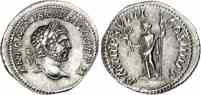
Caracalla Silver denarius issued AD 215 Obv: ANTONINVS PIVS AVG GERM, Laureate head right Rev: PM TRP XVIII COS IIII PP, Pax standing left, holding branch and sceptre
Very Fine-Extremely Fine
|
AUD $260.00
|
|
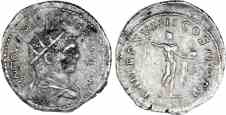
Caracalla Silver antoninianus issued AD 216 Obv: ANTONINVS PIVS AVG GERM, Radiate, draped bust facing right Rev: PM TRP VIIII COS IIII PP, Sol stg, one hand raised, other holding globe
Very Fine
|
AUD $210.00
|
|
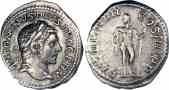
Caracalla Silver denarius issued AD 216 Obv: ANTONINVS PIVS AVG GERM, Laureate head right Rev: PM TRP XVIIII COS IIII PP, Jupiter, naked, standing front, head left, holding thunderbolt and sceptre
Very Fine-Extremely Fine
|
AUD $200.00
|