
We travel long roads and cross water to see what we disregard when it is under our eyes. This is either because nature has so arranged things so that we go after what is far off and remain indifferent to what is nearby, or because any desire loses its intensity by being easily satisfied, or because we postpone whatever we can see whenever we want, feeling sure we will often get around to it. Whatever the reason, there are numbers of things in this city of ours and its environs which we have not even heard of, much less seen; yet, if they were in Greece or Egypt or Asia … we could have heard all about them, read all about them, looked over all there was to see. Pliny the Younger, Epistles, 8.20.1-2
At the age of fifty a person has probably accrued enough sins and misdemeanours that can only be absolved by a pilgrimage and a Pope. The Via Francigena, or Frankish Way, is a pilgrimage route that stretches from Canterbury in Kent, UK, to Rome in Italy. It is a road I have wanted to walk for years, but previously my wife Katrina has been less than keen. We both enjoy walking, but walking for months on end carrying everything on your back has never strongly appealed to her. However, in 2023 I will be turning fifty and it seems right to honour the milestone in some fashion. For my wife’s fiftieth I fulfilled her wish to spend it on a six month holiday through Europe culminating with six weeks in the Greek Islands. I was ready when she asked me how I would like to spend my fiftieth.
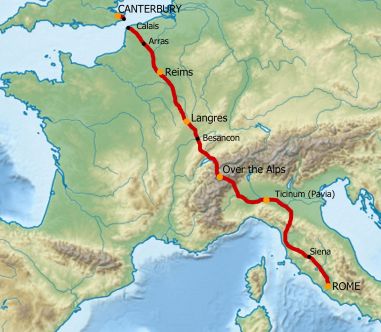
Since then she has been fully on board, reading, preparing, even training. The plan is to fly to the UK in late April. On the 1st of May, we will set forth from Canterbury Cathedral and walk towards Dover. We will cross to Calais on the ferry and enter France, following the Via Francigena through to Switzerland. About the halfway mark (Summer) we expect to be at St Bernard’s Pass and entering Italy. We will walk down the Po Valley and across Tuscany through Autumn to walk into Rome on the 28th October 2023. Figure 1 is a rough plan of the entire route. That is the plan, and along the way we will doubtlessly encounter many reasons to abandon this plan. This series of articles for Australian Coin Review will hopefully deliver a monthly update of our travels, not just through Modern Europe, but also through history and coinage.
It is not for absolution, however, that I take up this journey. Unfortunately, I have led a fairly blameless life and, while brought up a Catholic, I am not religious at all. For Katrina, being a heretical Protestant, a pilgrimage has even less appeal. This journey instead appeals to my childhood self. As a kid, it was the journeys of Bilbo Baggins in the Hobbit, who could walk from the front door of his home and across mountains and through forests on an adventure that I found endlessly wonderful. For Tolkien and his English readers, it was probably not particularly marvellous – Britain had long had countless paths and right of ways. But for an Australian child I tried to imagine walking from my door, through the town and into the countryside and away – the only way I could see was walking alongside busy and dangerous highways, which was not particularly appealing. Today, walking is the ultimate in slow travel and every trip I take to Europe I like to take the time to drink in the sights and history.
The Via Francigena as a pilgrim route is not well known in modern times, being overshadowed by the more famous pilgrim route, the Camino to Santiago de Compostela in Spain. It is also less serviced, it sees fewer pilgrims and has less hostels. However, from the seventh century AD it was a major route for pilgrims. Pilgrim routes in medieval times, unlike other routes, did not make much use of the old Roman roads, as they were built to connect cities and for trade. The pilgrims travelled between abbeys and churches, where they were assured cheap accommodation, as well as religious sights. Sigeric, the Archbishop of Canterbury made the trip from Canterbury to Rome and back to receive his pallium (the vestment of a Primate of the Church) from the Pope in AD 990. The journey back was recorded as a series of way posts by an anonymous member of his retinue, and has since become the established route of the Via Francigena, a road that probably had countless deviations and alternate routes.
As we travel the Via Francigena we will not only be taking in the sights and sites of Celtic, Roman and Medieval Europe, but also considering their coins. Canterbury and Kent, both named after the originally Celtic people that lived there, the Cantiaci, are home to some important Celtic, Roman and Saxon history. The Cantiaci, with their close relationship with nearby Gaul on the mainland, were among the first British people to issue their own coinage. The Roman roads from the important Roman ports of Richborough and Dover converged on Canterbury, then known as Durovernum Cantiacorum, before continuing to Londinium. On the Kentish coast first Julius Caesar and then, almost a hundred years later, the Emperor Claudius landed, and it is where the Later Roman Empire built their Saxon Shore forts. The coins of Roman Britain were abundant, but ceased active circulation after the Romans left and the Anglo Saxons moved in. For much of the fifth and sixth century the Saxons did not issue coins. The kingdom of Kent, settled by the Jutes, however, like the Cantiaci before them, kept strong relations with their neighbours across the English channel and it was at Kent that Christianity first took root in Saxon England as well as being one of the first Saxon kingdoms to begin the issuing of coins.
The next important site along our route will be Reims in France. Named after the Celtic tribe, the Remi, they long issued unique coins, in gold and potin. The Remi were allies of Julius Caesar, and in the Late Empire the Emperor Julian used Reims as a base to take back Eastern Gaul and the German frontier for Rome. When Gaul eventually fell to the Franks in the sixth century, Reims was a capital for the various Frankish kings that followed Clovis, who struck scarce and beautiful examples of Merovingian coinage.
A similar pattern can be found at Langres. Now it is a picturesque walled medieval town in France. It used to be the capital for the Lingones tribe who, together with their neighbours the Aedui and Sequani, issued Celtic staters modelled on coin types of the Roman Republic. These tribes were the main-stay of Roman Gaul. During the medieval period, the Bishop of Langres issued rare hammered coins – a feature of medieval coinage was that local rulers, even clergy, issued coins as issuing coins was no longer the sole prerogative of kings.
After Langres we will cross into Switzerland and over the Alps. In the Celtic times this was the land of the Helvetii. Of course the major historical figure associated with the Alps was Hannibal. Unlike him we will be crossing without the aid of elephants. Although there is some argument regarding which pass Hannibal used, he probably did not use the pass we will be using, Great St Bernard Pass at an altitude of over 2000 metres.
From there we will pass in Italy and the Po valley. The Via Francigena will take us through Pavia, known as Ticinum in the Roman period. Ticinum was an important Roman mint from the Third Century AD, and we will examine some of the coins and types that were particular to that mint. From there we will move south through the Tuscan countryside and Etruscan towns and coins.
Finally we hope to reach Rome on the 28th October. While this is my birthday, it is more widely known as the day that the Emperor Constantine defeated Maxentius at the Battle of the Milvian Bridge in AD 312. Maxentius, the son of the Emperor Maximianus and Constantine’s brother-in-law, was an intriguing figure usually forgotten in Roman history. He brought magnificent buildings back to Rome, the capital that had been forgotten, as well as instituting interesting coin types in an age where the Imperial coin types had become formulaic and staid.
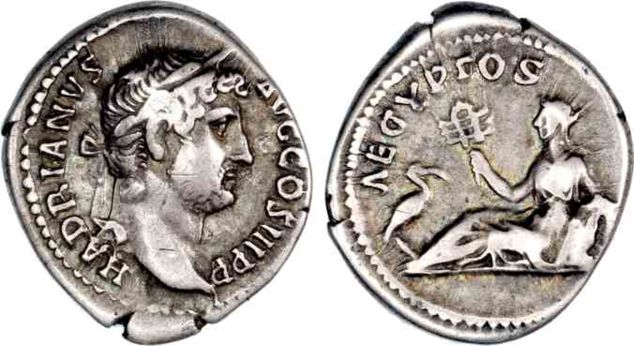
Travel for tourism is nothing new. In the Ancient World travellers would flock to important cities and sites to see magnificent temples and marvel at places of historical or mythological importance. In the second century AD Pausanias wrote a travel guide to Greece which has survived to modern times. Hadrian, Emperor of the Roman world AD 117-138, made several famous tours of his empire and issued coins commemorating the provinces he visited (see Figure 2 a silver denarius of Hadrian depicting Egypt). The quote at the beginning of this article from Pliny the Younger (also in the second century AD) indicates some of the aspects of tourism that have not changed in almost two thousand years. During the medieval period, tourists were often pilgrims enroute to important holy places, stopping along the way to see churches and relics. Today tourism is big business, at first glance less religious, but millions travel the world with almost equal fervour to see the “bigs” such as the Eiffel Tower, Big Ben and the Colosseum. According to Casson, the one difference with modern tourism is the desire to also see natural wonders, something rarely remarked upon in the Ancient and Medieval worlds.
A walk of 2000km, carrying everything on my back? You’ve got to be kidding … but, it is his special birthday milestone and of course I’ll do anything for the love of my life! Plus I get to travel through Europe and enjoy many ancient sites. So, I’ve been reading up on the Via Francigena both in print and online, joined a few facebook groups (a general VF walkers group, a female only walkers of the VF, and one dedicated to Aussies and New Zealanders), and chatted with friends who’ve hiked and done Caminos. Am I prepared? Hmm, not sure. But the prep is a journey in itself.
One of the delights of our move to Tassie is the closeness to the great outdoors and many walking and hiking paths. The commercial result of wilderness on our doorstep is a multitude of outdoor stores which I have spent many hours in recently – the staff are generally very knowledgeable and helpful, plus patient explaining the virtues of merino and bringing out yet another hiking boot for a fitting. Balanced with equipment recommendations online and in guidebooks (eg Cicerone), I arrived at my ideal pack – a 32 Litre Osprey Mira backpack, 2 merino shirts, 2 hiking pants/leggings, 1 light fleece, merino underwear (who knew???), toe socks and 2 pair merino socks plus boots and a jacket.
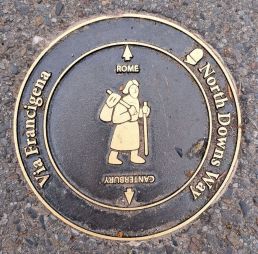
Why walk a pilgrim route? Who does this and why? For us this is slow travel in the extreme, a luxury in our busy modern lives. It is a chance for us to connect with a bygone era and experience first hand (albeit it with modern shoes, heating and comfy beds) the locations and objects along the way created and used by Romans, Britons, Franks and Gauls. The pilgrims who travelled overland from Britain to Rome utilised a route through France which has come to be called the Via Francigena (fran-chee-ge-na) – the way of the French people. Modern leaders recognised that connecting municipalities along the route would aid a united Europe and in 2001 the European Association of the Via Francigena ways (EAVF) was established to develop the infrastructure. The modern route takes in 5 countries (England, France, Switzerland, Italy and Vatican City) and is a “Cultural Route of the Council of Europe”. The way is sign-posted with a stylised pilgrim image, displayed on signs and plaques (see Figure 3, the plague outside St Augustine’s Abbey in Canterbury).
For me, Europe has always held a special allure, compelling me to visit yet again. I love the contact with a tangible history. Romans, Greeks and Egyptian myths and real-life legends appeal to me and the opportunity to explore the remains of these great civilisations is one I can’t help to grasp. The coinage provides a wonderful and diverse record of these achievements and it never ceases to amaze me that we can, some 2000 years later, still hold these records in our hands.
This article has appeared in Australian Coin Review magazine, June 2023.