
Kent is the closest part of England to mainland Europe and it has long been a stepping stone for the movement of people, goods and, more importantly, ideas into Britain. Kent was the first port of call (literally) for both Roman invasions – it was also one of the first areas to become Saxon. It was the first place to issue coins in Celtic Briton and it was the first kingdom to convert to Christianity during the Dark Ages.
Kent, “The Garden of England”, and Canterbury in particular is teeming with tourists. We hear voices of many nationalities as we walk the cobbled streets viewing the fresh fruit and veg from local vendors. Tour buses fill entire carparks and restaurants, punt outings, Chaucer experiences and ghost tours are all full. The beautiful gardens which line the Stour are packed with people enjoying a little sunshine.
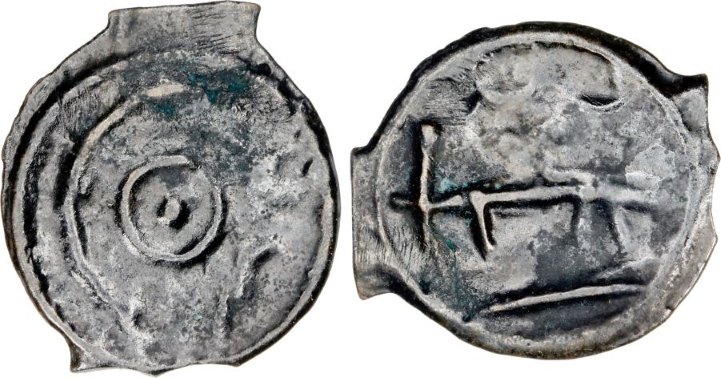
The Celtic people who lived here in pre-Roman times were the Cantiaci (also known sometimes as the Cantii) who lent their name to the city that grew up around their capital, Canterbury, and to the county itself, Kent. It was because of their exposure to mainland Gaul that Julius Caesar described them as the most cultured of the Britons. The concept of British coins, an idea that came from Gaul, started amongst the Cantiaci, around 100 BC with Kentish Cast Bronzes. These coins were copies of types issued from Massilia (modern Marseilles), which gradually became thinner and more stylized (see Figure 1). The obverse depicts the head of Apollo and the reverse depicts a bull. Later coins of the Cantiaci were struck in silver and gold, and then dynastic coins were struck for kings such as Dubnovellaunos in the late first century BC.
As we check into our hotel, we notice with glee a glass floor over Roman remains below. We gaze down repeatedly over the next few days as we recover from the flight and buy the last remaining items for our journey.
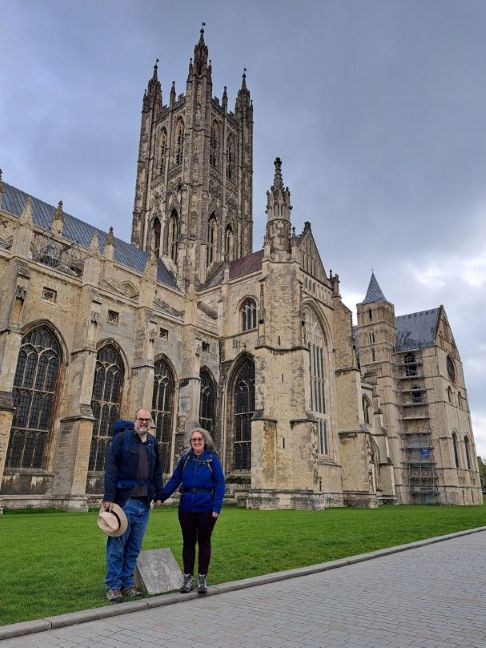
Built on the remains of a Saxon church, Canterbury Cathedral was founded in AD 598 and its impressive architecture is the result of hundreds of years of building and rebuilding. Master stonemasons brought French techniques across the Channel, filling humble pilgrim/tourists with awe even today. As we sit through the service and subsequently receive our pilgrim’s blessing (at the site of Thomas A’Beckett’s martyrdom) from Sub Deacon Tim, we cannot help to feel overpowered by the majesty above (see Figure 2).
Being the stepping stone into Britain, however, the Cantiaci were the first to encounter the Romans. First Julius Caesar, who sighted the white cliffs on the morning of the 26 th August 55 BC (Caesar, Gallic War , 4.23) and landed somewhere up the coast from Dover. Caesar had mixed success and had to return to Britain a year later. His “invasion” was probably more for show than a serious attempt at conquest. Almost a hundred years later, Claudius completed Caesar’s first forays, landing at Richborough in AD 43, establishing a bridgehead in Kent and moving inland. The civitas (tribal capital) of the Cantiaci became Durovernum Cantiacorum, modern day Canterbury. Originally the main port of call for the Romans was Richborough, but in the third century Dover (known to the Romans as Dubris) had overshadowed Richborough. The Roman fleet of the English Channel (known as the Classis Britannicum) had its base at Bolougne in Gaul, but a secondary headquarters was set up in Dover at this time. Excavations at Canterbury also demonstrate that the gate to Dover had become the largest and most important coastal gate.
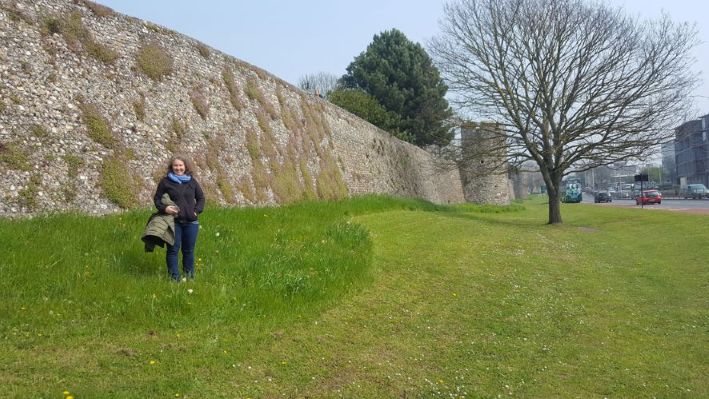
The city walls of Canterbury (see Figure 3) are still largely intact, and we pass through one of the many Gates on the start of our journey past St Augustine’s Abbey and on to Rome. We travel along streets but are quickly out in the countryside, pausing at St Martin’s church for our first breather. The pack is starting to feel heavy on my hips, but according to the many hiking store specialists I consulted this is good! I am very aware of my feet, hopefully they will hold up and I’m relieved over the next couple of days as my boots seem more comfortable and although weary and a bit sore, I have no pain.
As a Roman province Britain could be troublesome, both externally and internally. It was a frontier province exposed to the Picts in the north, the Irish to the west and the Saxons to the east. At least three legions were permanently stationed in Britain during the first three centuries of Roman rule. Such a concentration of military power also meant it sometimes became a base for a usurper wishing to challenge the official emperor in Rome. In the late second century AD Clodius Albinus, a governor of Britain, unsuccessfully challenged Septimius Severus for supreme rule across the empire. During the middle of the third century it, along with Gaul, broke away as the so-called Gallic Empire for some years before it returned to the fold under Aurelian. Only about twenty years later the errant commander of the British fleet, Carausius, set himself up as Emperor in Britain and northern Gaul until Constantius I (the father of Constantine) defeated the rebel forces. Around this time the Saxon Shore forts were constructed, mostly in Kent, to defend Britain from Saxon invaders. In the late fourth century and early fifth century Rome cut her losses and started withdrawing the legions from Britain, which were needed to the defend the mainland provinces from Barbarian invasions. Kent, as one of the first places conquered by the Romans in Britain, was probably one of the last places they left from.
The city behind us, we enjoy the rolling green hills of the countryside. The Via Francigena path is clearly marked as it twins with the North Downs Way and guides us southward. The May Day public holiday makes it difficult to find accommodation in Shepherdswell (Bishop Sigeric’s waystop) so we stay in Aylesham. Unable to walk once we arrive, and cursing the extra mile or two off our path, we soak in a bath and sit in up in bed to order a home delivery to our AirBnB. Heaven!
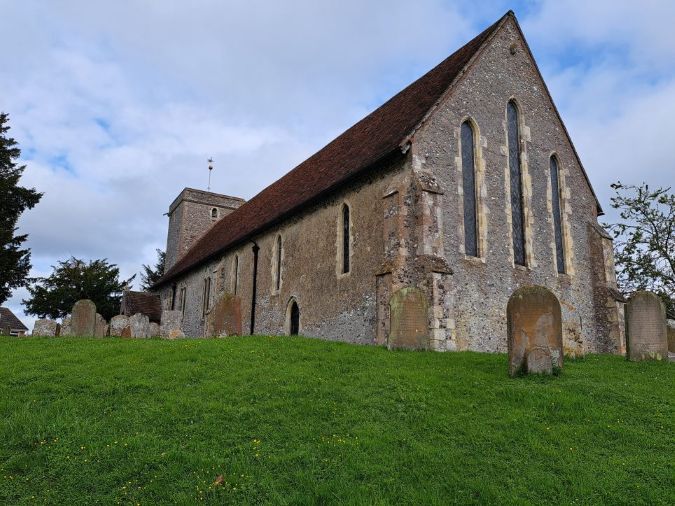
Post Roman Britain returned to a similar state as before the Roman conquest. Hillforts that had been abandoned for four hundred years were re-established and so were the tribal identities and cultures. As Mattingly points out, however, in some ways the situation was worse than pre-Roman Britain, particularly in the areas of pottery, craft production and coinage, which had not been produced for more than two hundred years. The pagan German tribes moved in to fill the vacuum left by the Romans, Kent falling quickly to the Jutes, although as the Kingdom of Kent it retained its former link to the Celtic tribe that lived there. Canterbury became the capital of the new “barbarian” kingdom. Once again, however, it became a stepping stone for ideas from the continent. In AD 580 Ethelbert the King of Kent married Bertha, a Frankish Christian princess, on the provision that the pagan king allowed his new bride to continue her worship in peace. Pope Gregory sent St Augustine as a missionary to convert the English, using Kent as a base. The Church of St Martin, just outside Canterbury, as recorded by Bede, was originally a church in Roman times and was rebuilt for Bertha’s use (see Figure 4). With this as a base St Augustine was able to convert the king to Christianity and hence the rest of the small kingdom. A larger abbey was started by Augustine and a similar procedure steadily converted the other surrounding pagan kingdoms – daughters and granddaughters of Ethelbert and Bertha were given in marriage to pagan kings on the provision that the brides be allowed to practice their religion. A cathedral was later built in Canterbury, St Augustine becoming the first archbishop and Canterbury has remained the principal site for Christianity in England ever since.
It is journeys like this, stretching friendships and marriages, that cause one’s mind to wander as you walk. As Matthew and I struggle with our bodies, unused to this walking malarky, we rediscover (how could I have forgotten???) our different walking styles. As we progress through the day, I prefer more frequent stops, declining in energy. Matthew, however, quickens his pace as he sees the end in sight. My shorter legs have me climbing more slowly and going faster on the way down, whilst Matthew does the opposite. At least this is my impression, Matthew maintains that his pace is even and constant!
Our walk takes us along well-worn paths, including bridle paths and we encounter riders occasionally, dogs and their owners frequently, and wildlife constantly. Quite a few people we meet wish us a good camino, and a few chat at length about where we come from and where we are off to. It is lovely to hear the different English accents and their wonder at the journey we have chosen to undertake.
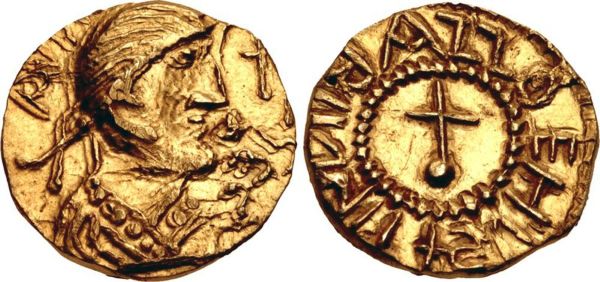
It is no surprise therefore to learn that Kent was where the production of coins re-started in Britain. King Eadbald of Kent (the son of Ethelbert and Bertha) was the first Anglo-Saxon to issue coins in the early seventh century. These early gold shillings (scillingas, see Figure 5) were modelled on the designs used by the neighbouring Merovingian Franks. They were soon replaced by smaller thicker silver sceattas and then, in the eighth century, by the silver penny, which became the principal denomination of English money for centuries. For crossing to England, the main port in Gaul was Boulogne, which later was replaced by Wissant and finally by Calais. On the English side of the channel the principal port has always been, since the third century AD, Dover. On returning to Canterbury after receiving his pallium from the Pope, Bishop Sigeric crossed from Wissant to Dover, stopping at Shepherdswell before making the final leg into Canterbury.
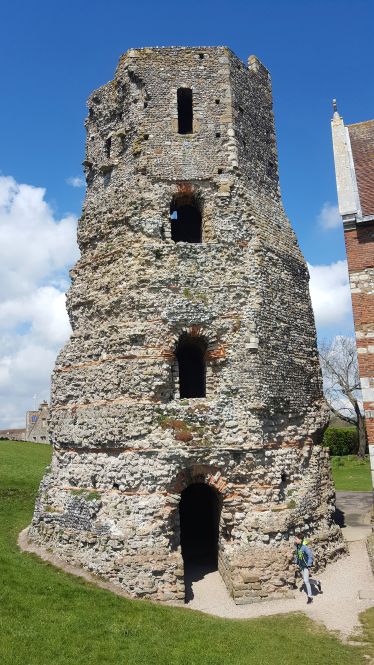
As we wend our way through sprawling Dover, we are ever conscious of the castle above, keeping watch in times past. One of the two lighthouses that guarded the harbour of Dubris remains in the Dover Castle grounds (see Figure 6). Built to guide shipping across the channel soon after the Roman conquest in the first century AD, the Dover Pharos is the only Roman lighthouse in Britain and the most complete standing Roman building in England.
We are filled with hope for our pilgrimage and optimism that our bodies will survive what feels at this time as a gruelling ordeal. A nice hot soak (or two!) in a Dover bath, a full English breakfast, and a relaxing ferry trip across the channel set us up for the next stage.
This article has appeared in Australian Coin Review magazine, July 2023.