
The first section of the Via Francigena in France takes us through the old Roman province of Gallia Belgica, in particular through the territories of two main tribes: the Morini and the Remi. It was Julius Caesar who famously subjugated these tribes during his Gallic War (58-50 BC). During the later Roman Empire, the Caesar Constantius I and later the Emperor Julian fought the Franks and the Alemanni to protect these areas of the empire, but these German tribes remained a menace, the Franks eventually conquering all of Gaul from what remained of the Empire, from which was born the kingdom of France.
We are in France! It is such a thrill to be surrounded by Boulangeries and Patisseries and the burble of foreign climes. After a smooth crossing we board the free shuttle bus into Calais and jump off near the famous Burghers statue where we get our first French pilgrim stamp at the Mairie. Dinner is our favourite Moules Mariniere with lots of bread and frites. Our apartment has coffee (pour moi) but no black tea (pour Matthew), the story of accommodations to come. I’m justifiably thrilled though when Matthew comes back the next morning with fresh pastries for breakfast. Pane au chocolat and croissant aux amandes to die for!
The next morning we head out into the French sunshine along the canal to Guines. The next few stages are fairly flat, my legs are grateful. We pass through large forests carpeted with bluebells, meet other pilgrims (including one from Australia), stay in an old mill and at the abbey at Wisque (a silent order but we hear them singing).
As we head out of Therouanne we are disappointed to discover that the museum is closed. We are consoled by a rather knowledgeable guide who, upon discovering Dr Matthew’s background knowledge of the Morini history etc opens up and reveals a fabulous little museum collection to us. Our personal tour unfolds - coins of the Morini, Roman glass and pottery, plus stone capitals etc from municipal buildings abound. In the small space technology comes to the fore and there are videos of the digs including mosaic removal. There is also a collection of medieval pilgrim ampules. We are delighted!
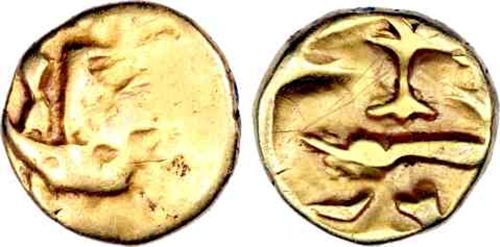
Therouanne, then known as Tarvanna, was the capital of the Morini tribe, who fought against Caesar during his conquest of Gaul. They had several ports with access to Britain and Caesar needed these for his invasion of that island. Water was central to the life of the Morini, not only in the case of their coasts and ports but also the swamps and rivers which they could withdraw into when invaders came. This is demonstrated on their coins, such as this small gold piece (see Figure 1) that depicts (in Celticized style) figures with a boat on the obverse and on the reverse lines under a tree that is thought to represent water.
We wake up to the gentle peal of church bells and walk out into the hazy French sunshine full of pastries and coffee. As we walk through the small villages we also discover delightful little (sometimes big) vending machine shops with local produce. Although it is sad that they no longer have a local shop, access to fresh bread, cheese and produce is a boon to the walker who just wants to swig a litre of fresh pear juice.
Our path takes us on some lovely forest walks and we stop at a ruined abbey in the middle of nowhere for a rest. We wolf down Croque Monsieur for lunch, and later in the dining room of our hotel spot a cabinet full of local finds. I find some roman coins amongst the pottery and delight in serendipity.
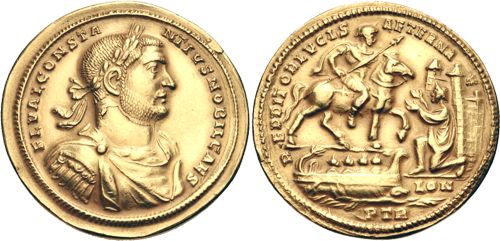
It was at Arras that a famous hoard of Roman gold coins were found in 1922, known as the Beaurains treasure. Unfortunately, the hoard was dispersed through the Antiquities department, although some parts were retained by the Arras Museum and the British Museum. The most famous piece is the Arras Medallion (see Figure 2) which depicts the Caesar Constantius (the father of Constantine) entering Londinium in triumph after crushing the forces of the usurpers Carausius and Allectus in AD 296.
We see Laon looming on the horizon for most of the day as we approach across the Picardy plain. Our path takes us in a decreasing circle as we walk through the spread-out lower town heading for the enormous flight of steps which take us up, 100m, into this hilltop fortress. Magnificent!
The streets are quiet, it is Monday afternoon, as we search the old stone buildings for our street and number. Only local cars are permitted, so there are few vehicles up here and most are in the central carpark. The Cathedral looms over the square, we easily take photos devoid of other travellers. We walk around the windy city walls and book a tour for the next day. The underground passages are fabulous! We are taken to a Roman grain store, later used to imprison 13 Templars on Friday 13 October, 1307. On the walls we can see the mark of the cross and a place for a candle.
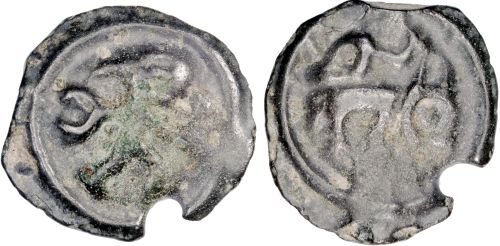
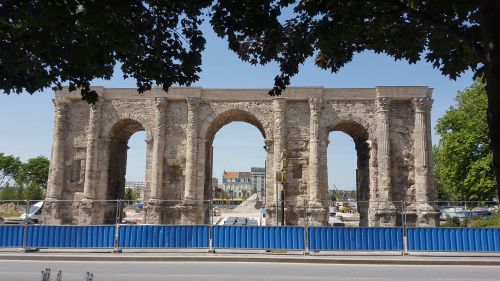
The city of Reims retained the name of the former Celtic tribe that inhabited the area, the Remi. Unlike the Morini, the Remi allied themselves to Caesar during his conquest of Gaul and remained loyal to the Roman cause. This Belgic tribe issued several types of potin coins, one of the most common being the “pig-tail dancer” type, which is a potin (an old compound of copper, zinc, lead, and tin) cast coin depicting a Celtic warrior wearing pig tails and holding a torc on the obverse, and a Celticized bear on the reverse (see Figure 3). During the Roman period, the city was known as Durocortorum, and had four monumental gates, only one of which, the Porte de Mars, has survived (see Figure 5). For this area of Gaul much of the coinage was provided by the mint in Lugdunum (Lyons) to the south during the first century AD, and then by the nearby mint at Trier for the fourth and fifth centuries AD. During this period this area of Gaul was vulnerable to barbarian incursions over the Rhine frontier.
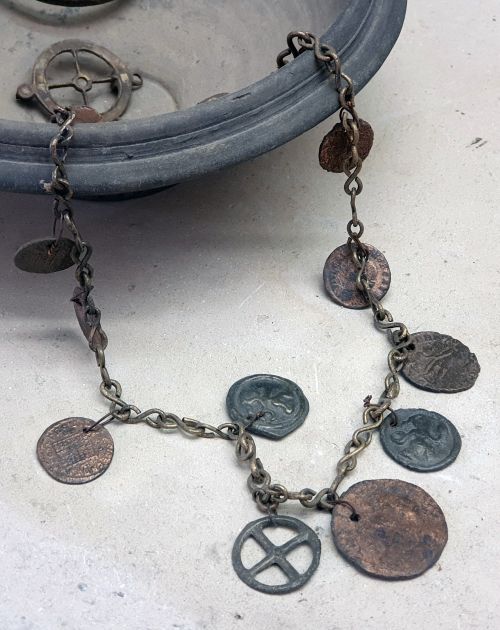
In contrast to Laon, Reims is set on a bend in the river, flat, with wide canals extending outwards. We start to see more river traffic, and a lot of casual joggers and cyclists enjoying the treelined canal paths. The cathedral is teeming with tourists, each aspect of the structure a mass of detailed sculpture. We enjoy the sun. Unfortunately the Roman Cryptoportico, one of only a few uncovered intact, is not open on the days we are here, and the Porte de Mars gate is even more covered in renovations than it was in 2019 (see Figure 4). The museum however, is better than ever. We view the sarcophagus and discover some interesting aspects of the coin displays. Two necklaces of the early medieval period feature ancient coins – the necklaces are made up of coins, including pigtail dancer Celtic coins and those of the Emperor Licinius covering a mint range of 400 years, and of course are holed (see Figure 5). Mistakenly perhaps, I had always assumed these ancient holed coins were worn singularly, but here we see examples of multiples – and collections at that!
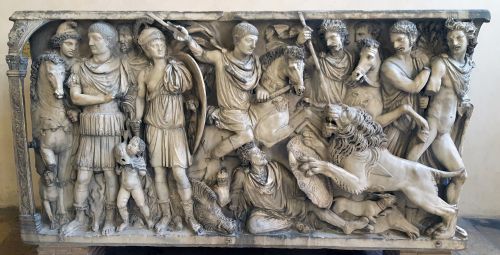
In the mid 300’s several tribes, such as the Franks and the Alemanni, had occupied the Rhine frontier. Earlier the Caesar Constantius I fought these tribes, particularly the Franks who were allies of Carausius and Allectus, the usurpers in Britain and Gaul that Constantius had to defeat. Constantius’ grandson, the emperor Constantius II, faced fresh incursions from these tribes. He appointed his own nephew Julian as Caesar in the West in AD 355 to help deal with this situation. Julian made Reims a base and fought several successful campaigns against the German tribes, retaking the Roman frontier. Jovinus, a native of Reims (although he might have been of Germanic origin) was named magister equitum (or “master of the horse”) by Julian. When the emperor demanded some of Julian’s loyal troops for a campaign against Persia the troops mutinied and proclaimed Julian emperor. Constantius died in 361, leaving Julian as sole emperor. During his short reign Julian attempted to stem of the tide of official Christianity in the empire but died in 363 while on campaign against Persia. Julian’s appointees, such as Jovinus, remained in place but when the new emperor Jovian attempted to replace Jovinus, the troops in Gaul again mutinied and attempted to proclaim Jovinus as emperor. Unlike Julian, Jovinus was able to refuse the honour and pacified the troops. As a reward Jovinus was promoted to magister militum (or “master of the army”) a post he held into the reign of Valentinian. In AD 367 Jovinus was further rewarded with the consulship. When he died, Jovinus was buried in Reims in a magnificent repurposed sarcophagus (which still resides in the Museum at Reims, see Figure 6) – one of the few people to have rejected the proclamation of emperor and survive!
Although Julian and Jovinus had pushed back the Franks, it was only a temporary restoration of the frontier. The Franks became Roman allies and were eventually given land within the empire to settle. During the late fifth century their king, Clovis, took advantage of the Roman disintegration in Gaul to seize more land. The Franks at the time were pagan but Clovis’ bride, the Burgundian princess Clothilde was Catholic and it was at Reims that Clovis and thousands of his people were baptised by St Remigius, the bishop of Reims. Reims has remained one of the primary sees of Christian worship in France ever since. Clovis’ dynasty, the Merovingians, ruled the Kingdom of the Franks (which was to become France) for centuries. It was a foible of the Franks that inheritance was split equally between heirs. When Clovis died in AD 511 he left behind a massive kingdom that incorporated most of Gaul, but he also left four sons, and the kingdom was divided between them. Theuderic, the eldest, inherited the lands based around Reims and Reims became one of the Frankish capitals. Clovis’ grandson, Charibert, a Frankish king in Paris, gave his daughter Bertha to King Ethelbert in Kent, kickstarting the Christian conversion of England that was mentioned in our previous article. The subsequent history of the Frankish kings, who regularly quarrelled, betrayed and murdered each other is faithfully recorded by Gregory of Tours.
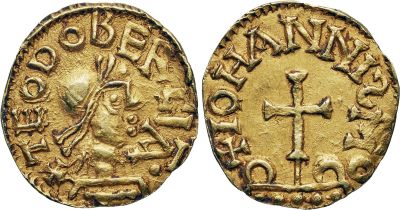
The Merovingian Franks also issued coins which are scarce and much sought after by collectors. Theudebert, the son of Clovis, was the first to issue royal Merovingian coins, based on the Byzantine solidus (see Figure 7). The Merovingians issued a smaller gold coin termed as triens , and also issued silver deniers. The descendants of Clovis continued to expand his realm, but the Frankish laws of inheritance prevented any single Frankish political entity remaining for too long. By AD 751 the power of the kings dwindled until the Mayor of the Palace, Pepin the Short, requested that the Pope crown him King of the Franks and the Carolingian dynasty was born. During his reign Pepin issued a silver standard coin to replace the Merovingian gold. Pepin’s son, Charlemagne eventually became king of the Franks and Holy Roman Emperor, but the Carolingians still kept the Frankish custom of dividing realms upon inheritance. Charlemagne fortunately only had one son, Louis the Pious, but Louis had three sons and the Carolingian realm was divided into three, the progenitors of the modern states of France, Germany and Italy.
This article has appeared in Australian Coin Review magazine, August 2023.