
After Reims we start leaving Gallia Belgica and move into territory that was sometimes part of the Roman province of Germania Superior and sometimes part of Gallia Lugdunensis. These lands belonged to two main Celtic tribes: the Lingones and the Sequani. After Julius Caesar’s thorough conquest of Gaul between 58 and 50 BC, these lands are often assumed to be peacefully integrated into the Roman Empire for over four hundred years. Along our journey through this part of France we will look at Gaul through the Roman period and particularly at the times it was rebellious. It is often quoted that of the three million inhabitants of Gaul in the first century BC, one million were killed during Caesar’s conquest and another million were enslaved. Thereafter Gaul became a subdued and willing partner in the Roman Empire and this idea may have been true for the first century after Caesar, though probably through sheer exhaustion. There were also many serious and half serious attempts at rebellion in Gaul from the first to the fourth centuries AD – some were opportunistic, others born from some form of nationalism. Three of these insurrections saw their end in the lands we walk through.
We walk out of Reims along canal paths that are mostly shaded in the increasing heat. For the first time we are joined on our path by local joggers, cyclists and families all enjoying the glorious weather. We lunch on baguettes filled with cheese and ham as we watch energetic volleyballers before heading into the hills lined with vineyards. Unfamiliar with viticulture, we are bemused by leggy machines moving between the vines and scores of white vans gathering in seemingly random spots. We soon discover they are going about their jobs, not up to nefarious practices!
Grapes have been grown here since ancient times, the Romans planted vineyards in the Champagne region of northeast France in the 5 th Century, or possibly earlier. Ancient viticulture practices are one of the lasting legacies of the Roman Empire. For us, the endless hills of neatly planted vines are initially exciting (I take many pics, especially of well-known champagne house names) but they quickly become hills of endless hot unshaded paths and we crave the true source of life – water!
The most famous and most serious case of rebellion in Gaul was the so-called “Gallic Empire” in the middle of the third century AD. The year 259/260 could be considered the nadir of the third century crisis – the emperor Valerian had been captured on campaign against the Sassanid Persians and his son Gallienus was facing revolts in the Danube and the East. The coinage had been debased thoroughly, the main denomination being the antoninianus with only a slight silver wash. The Rhine frontier was safeguarded by trusted military commanders under the nominal leadership of Gallienus’ son Saloninus. After an argument over spoils, the army revolted and proclaimed Postumus emperor, and Saloninus was murdered. Gallienus, who was occupied in putting down other revolts in the heartlands, could not immediately concentrate on subduing the revolts in Gaul and the East. The situation became a stalemate in which Postumus ruled in Gaul (followed shortly by Spain and Britain), Odenathus the Palmyran ruled the East and Gallienus occupied Italy, Africa and the Balkans.
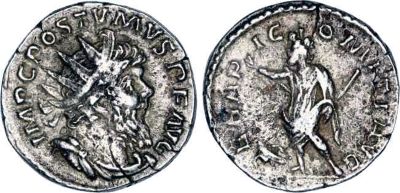
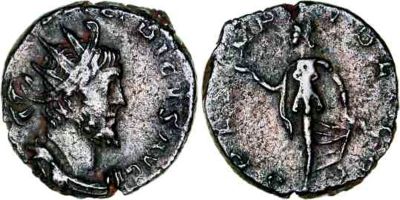
The empire of Marcus Cassianius Latinius Postumus, known as the “Gallic Empire”, was not a nationalistic movement – this empire had its own emperor, senate and consuls, all modelled on Rome. Postumus proved to be a successful emperor, although he never gained official recognition. He defended the Rhine frontiers successfully and his silver coinage had a greater fineness and silver content than the “official” issues from Gallienus (see Figure 1). His new empire, however, fell victim to the same disease that had plagued the third century – the inability to achieve political stability. After almost ten years of rule, his own soldiers rebelled in 269 and made one of their number, a certain Marius, emperor. Marius was swiftly despatched and replaced by Postumus’ lieutenant Victorinus. Victorinus fell victim to the mutinous army in 271 and was replaced by Tetricus (see Figure 2), who appointed his young son, known as Tetricus II, as his Caesar and heir.
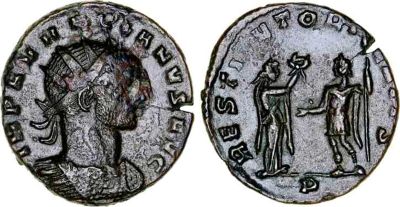
It was in a field outside Chalons (now known as Chalons-en-Champagne) that the fate of the breakaway state was sealed. By this time Aurelian had become the official Roman emperor in Italy and he took immediate action to repair the schism from the reign of Gallienus. By 273 Aurelian had defeated Zenobia in Palmyra and restored to the empire the Eastern provinces. In 274 he marched on the Gallic Empire and faced Tetricus at Chalons early in that year. Tetricus was soundly defeated (there were reports that he came to an arrangement with Aurelian and threw the battle in Aurelian’s favour) and the Roman Empire was now completely restored. Although Tetricus and his son were led in Aurelian’s triumph in Rome, the emperor pardoned them and the Historia Augusta even claims that Tetricus was given a minor office. Aurelian proclaimed on his coins RESTITVT ORBIS – restorer of the world (see Figure 3).
We head out of Chalons-en-Champagne along more canals, and wind our way through more vineyards as the pleasant French sunshine starts to get a bit hot for these Aussie walkers. Frequently we take refuge in the Laveries, the washing places of old, to eat our lunch. Not used to carrying loads on our backs, we quickly work up a sweat (in June!) and I start to book accommodation with pools. We dine on charcuterie boards poolside and happily spend 2hrs in one pool whilst waiting for our room to be ready…
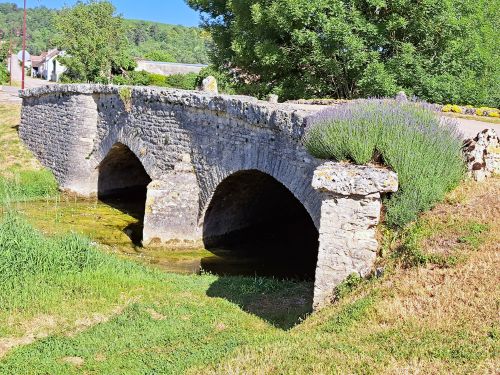
At Spoy we discover a Roman bridge still in use, lovingly preserved and celebrated with flower gardens and signage (see Figure 4). We walk across and up the steep but straight Roman road beyond towards the lovely Bar-sur-Aube.
What a fabulous city, perching on high, is Langres! We don’t see much of it until we are just below its magnificent walls but spend the afternoon admiring the (now filled in) Roman gate and walking the 3.5km city walls. We promenade with many others, a mix of locals and tourists. There are many university students here, and the cobbled streets are filled with restaurants and bars, all surrounded by the huge walls.
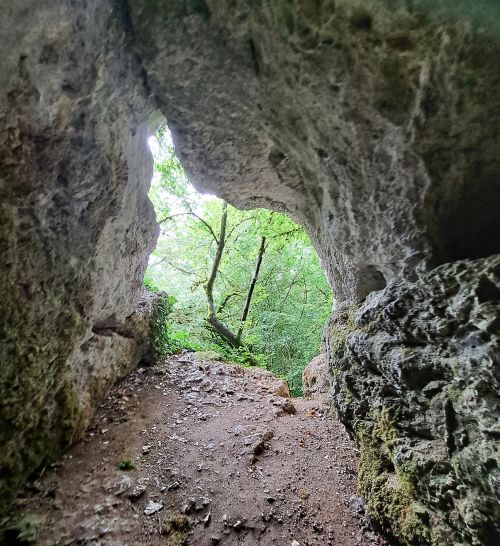
The city of Langres is in the centre of the territory of the Gallic tribe of the Lingones. One of the more infamous scions of that tribe in the first century AD was Julius Sabinus, who claimed his great grandmother was the Celtic lover of Julius Caesar and he was his descendant. After the death of Nero and then Galba, Otho and Vitellius in less than 12 months, Julius Sabinus, seized the opportunity for a rebellion, as told by Tacitus in his Histories . Despite Sabinus’ probably spurious blood claim to the Julio-Claudian dynasty, it did not appear to be a move to usurp the throne, but instead a nationalistic movement to free Gaul. Sabinus raised the Lingones in AD 71 and proceeded to attack the neighbouring Sequani, who remained loyal to Rome. The Lingones were routed. During Sabinus’ short rebellion he issued no coins. Tacitus relays a story that Sabinus faked his own death and set fire to a house where he was supposed to have committed suicide in order to escape justice. Sabinus’ wife Epponina helped hide him for eight years, keeping him in a cave near to Langres (see Figure 5). There was even a story that the two journeyed to Rome, Sabinus disguised as a slave. According to Plutarch, Sabinus was eventually recognised and captured, both he and his wife brought before Vespasian, now securely emperor. Plutarch says that Epponina castigated Vespasian for so long after he ordered her husband to be executed that he ordered her to be executed as well!
We enjoy the museum at Langres, including an interesting display featuring a failed rebellion which prompts us to walk off path to find the cave of Sabinus. It is surprisingly small given his long stay, we climb down and then up in a wooded gorge to the location local legends direct us to (see Figure 5). Perhaps the nearby spring gives credence? Finding the source of the Marne River is a nice bonus.
I sample many local champagnes, enjoying the hospitality of people who, despite the language difference, welcome us and share their enthusiasm for new things in both English and via google translate. In Bucey-les-Gy we are treated to a BBQ with spicy sausages, salads and local champagne and wines. It is very dry here at the moment and there are water restrictions in place. Just like home!
Only a few more days via forest paths, dodging attacks from wild boars (yet to see one), to Besancon.
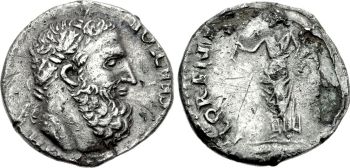
The city of Besancon has been a natural fortress for thousands of years. The oxbow route of the river looping around a high outcropping of rock at the narrow neck makes it very easy to defend. When Julius Caesar came here it was a settlement of the Sequani, a powerful Gallic tribe, called Vesontio. It was outside Besancon that one of the first Gallic rebellions against Rome ended. By AD 68 the reign of Nero had become unbearable for many within the empire. The first to rebel was Julius Vindex, the governor of Aquitania. Julius Vindex was from a Gallic noble family that had long held citizenship and had been amongst those that Claudius adlected into the Roman Senate. Since Aquitania held no legionary bases, Julius Vindex’s forces were meagre and it is not clear his objective was anything other than removing Nero from power. It was no attempt to forge a separate Gallic Empire and it was probably not his wish to become emperor himself. In fact it was Vindex who wrote to the governor of Spain, Galba, urging him “to make himself the liberator and leader of mankind” (Suetonius, Galba , 9.2). Both Vindex and Galba issued “Civil war” coins without an emperor’s head on the obverse (see Figure 6, a coin issued by Vindex), although some types of Augustus were re-issued. Vindex’s forces marched across Gaul and it was at Besancon where he met the legions from the German frontier under the command of Verginius Rufus. Vindex was crushingly defeated but the news must have been too late for the despairing Emperor Nero, who committed suicide in June AD 68.
The Sequani at Besancon proved to be loyal subjects of Rome. Not only did they defeat the later revolt of Julius Sabinus mentioned above, but over a hundred years later they erected a triumphal gate in honour of Marcus Aurelius and his successes against the Quadi and Marcomanni. The gate is still extant, known since Medieval times as the Porte Noire (the Black Gate, see Figure 7).
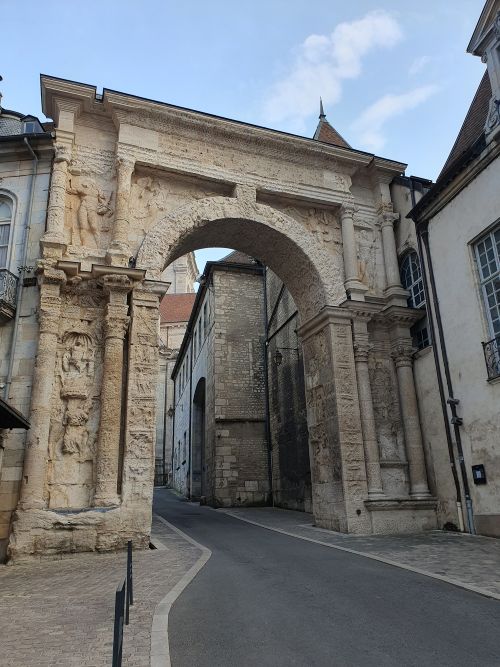
Besancon also has a great museum, including some large mosaics. There are some in situ which we view at night walking around the town and taking in the Porte Noir (see Figure 7) and the Square Castan as well. It is fascinating for me to learn about Auguste Castan, archaeologist and librarian, who brought to light eight Corinthian columns (possibly from the Arcier aqueduct) and assembled them in this quiet square near the Black Gate. There are many other fragments of inscriptions, capitals and columns. This collection of archaeological remains is a reminder of the early stages of this profession.
We spend a little time falling in love with Besancon, meeting up with friends and feeling truly lucky to be taking this journey together. It is a vibrant city, the old town girt by the river and walls, the medieval fortress looming above. We are in awe as we climb out of the river valley along a small stretch of Roman road and ascend to the plateau beyond.
This article has appeared in Australian Coin Review magazine, September 2023.