
Walking the Via Francigena for most of 2023 took us to some amazing sites but, tantalizingly, some equally amazing sites were just off the track. We were interested in the city of Milan, known as Mediolanum to the Romans, and had never had an opportunity to visit before. It was another Roman imperial mint city and the headquarters of Maximianus, colleague of Diocletian and tetrarch responsible for the Western half of the Empire. Some Roman ruins of this period remains, and the temptation eventually became too much.
It was going to be hard to walk straight past Milan, so we didn’t! We jumped on another of the efficient euro trains at the end of a walking day and spent the evening wandering the streets of this fashion capital. Unfortunately for me, blisters had featured greatly in my day’s walk so blister patches were the main accessory I was shopping for…
Mediolanum, now known as Milan, was a Gallic settlement in Northern Italy before it was captured by the Romans. Mediolanum was probably a Latinization of the Celtic words for “middle of the plain”. Its situation close to the Ticino river, a tributary of the Po, and adjacent to the Alps at the top of Italy gave it trade and defensive advantages. The Gauls had migrated across the Alps and settled here, according to Livy, during the time of the Roman King Tarquinius Priscus (Livy, 5.34). Cn. Cornelious Scipio (the uncle of Scipio Africanus) was elected consul in 222 BC and conquered the Gauls in the Po valley, including capturing Mediolanum.
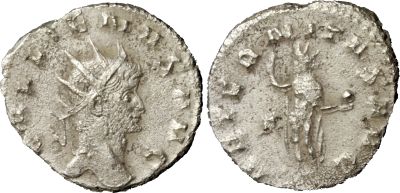
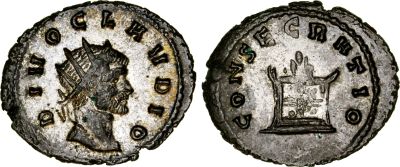
Mediolanum thrived during the Roman Republic and Imperial periods, but really became important in the Third Century AD. Around AD 255 the emperor Valerian decided to move the mint that had been operating at Viminacium to Mediolanum. Here numerous antoninianii were issued (although gold aurei as well as bronze denarii, quinarii and sestertii were also issued at times). It was at this mint that the Legionary Series in the name of Gallienus was issued (AD 257-259), depicting the “badges” of the Legion and enumerating them with their names (such as “LEG I ADI” for the Legion I Adiutrix, depicted with a capricorn). It was during the last issues of these coins (AD 259) that Gallienus won a victory against the invading Alemanni on the outskirts of Milan. According to Zonaras (12.24), Gallienus defeated 300,000 with just 10,000 men. Milan was then the base of Aurelous when he revolted against Gallienus in AD 268 (see Figure 1, an antoninianus of Gallienus issued from Milan just before this revolt). While Gallienus was besieging the city, he was murdered by a conspiracy amongst his captains (Victor 33). When one of those captains, Aurelian, later became Emperor, he moved the mint from Mediolanum to Ticinum, as described in our earlier article on Ticinum (see Figure 2 for an antoninianus issued by Aurelian for Claudius II Gothicus from the mint at Milan before it was moved). After Maximianus was appointed Augustus of the West under Diocletian in AD 286, he chose Mediolanum to be his capital.
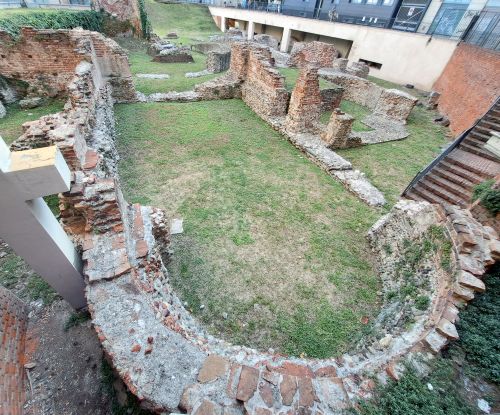
We checked in and took a Metro line into the city, getting off at the Duomo and walking to the remains of Maximianus’ palace (see Figure 3). The ruins are surrounded by more modern buildings, but the signage indicates the palace placement, and we found some local cats enjoying the afternoon sun. Nearby, we found mosaic fragments both open under building colonnades and viewed through clear floor panels in the streets. We joined the crowds in the Piazza del Duomo for a while, such an impressive large-scale building, and then found a nice sidewalk cafe for dinner.
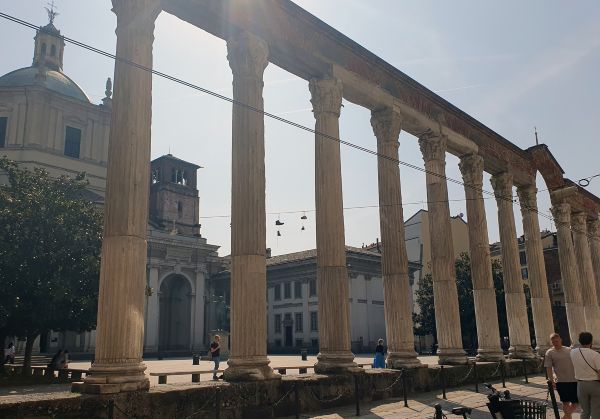
After a novelty sleep-in we again utilised our 24hr transport ticket and caught the Metro back to the Piazza del Duomo. We walked to the Colonnade of San Lorenzo which had some impressive columns stolen from a Roman temple (see Figure 4) and then viewed a Roman tower and the Circus Romana. Again, we joined the throngs around the Duomo and the massive renaissance palace.
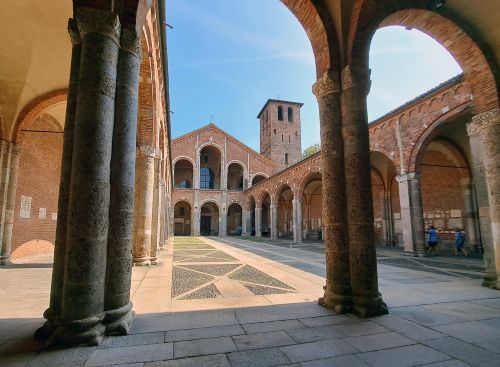
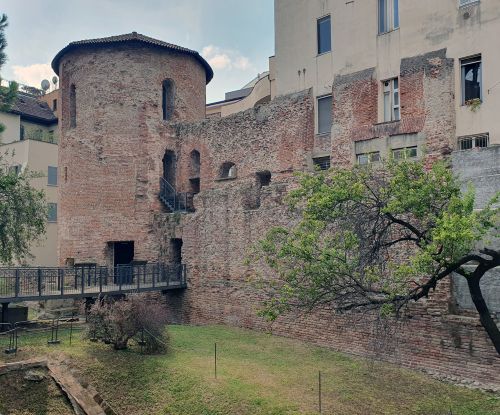
Unfortunately, when we arrived at the Basilica of Sant'Ambrogio (see Figure 5) there was a wedding in progress, so we were unable to view the supposed “Sarcophagus of Stilicho”. Luckily however, the Museo Archeologico was amazing. We viewed Roman, Greek and Etruscan artefacts plus sections of the late 3rd century city walls and one surviving polygonal tower. This three storey, twenty four-sided tower set in the original palace walls now contains part of the museum collection (see Figure 6).
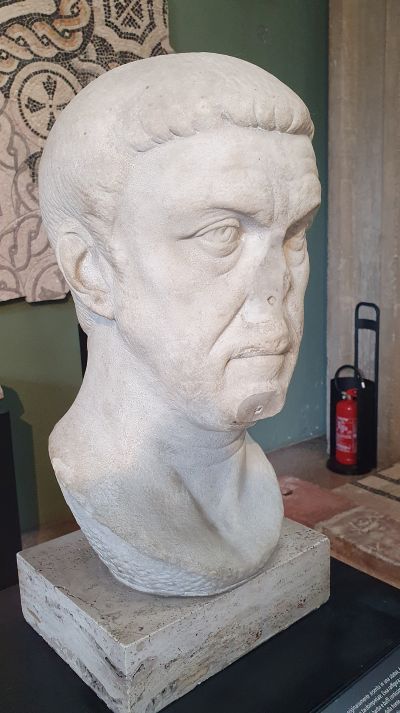
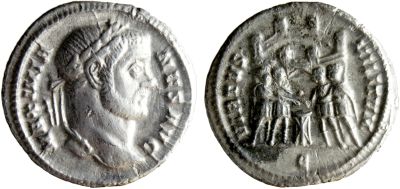
The emperor Maximianus (AD 286-305) is one of the more unusual and overlooked Roman emperors. In most histories he is dismissed as merely the loyal colleague of Diocletian, described as brutal and cruel, usually by Christian authors. Maximianus had a military background, most probably hailing from Illyria or Pannonia like many of the other military emperors of the third century AD (see Figure 7, a purported bust of Maximianus). After Diocletian became emperor in AD 284 and defeated his rival Carinus in AD 285, he realised that the empire was too large and too exposed at that time to be ruled by one emperor. The previous emperor Carus had given the West to his son Carinus to rule, and Diocletian expanded and formalised the process. On 1 April AD 286 he appointed Maximianus as his colleague and co-Augustus with responsibility for the West while Diocletian looked after the East. In AD 293 Diocletian went further and gave each Augustus a Caesar as a junior and eventual successor. In the West Maximianus received Constantius, who he invested as Caesar at Mediolanum on 1 March, while Diocletian appointed Galerius to assist him in the East. Ties of marriage bound the four rulers (“tetrarchs”) together – Constantius married Maximianus’ step-daughter Theodora, while Galerius married Diocletian’s daughter Galeria Valeria (see Figure 8, a silver argenteus of Maximianus with the reverse depicting the Tetrarchs in harmony).
For almost twenty years Maximianus assisted Diocletian loyally, a loyalty most unusual in the third century. Previously trusted generals had been sent to deal with military instability on the frontiers but then raised to be usurping rivals by the army, albeit sometimes reluctantly. For example, the Historia Augusta claims that Decius warned the emperor Philip not to send him to Dacia to handle barbarian invasions. Philip sent him anyway, trusting his honesty but when the army raised Decius to be emperor he complied and marched on Philip at Rome, overthrowing him and becoming emperor in his stead. No accounts however even hint of any disloyalty on the part of Maximianus (at least to Diocletian).
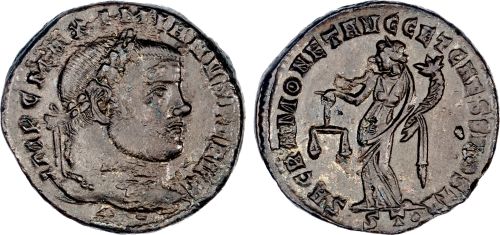
It was at Mediolanum that Maximianus made his capital, formally spurning Rome. Mediolanum, at the top of Italy, was more accessible to the Rhine and Danubian frontiers as well as sitting atop Rome where Maximianus could keep a watchful eye. In the East, Diocletian made his capital at Nicomedia. When Diocletian reorganised the mints, his capital Nicomedia became an Imperial mint, but he kept Aurelian’s arrangement which had moved the mint from Mediolanum to nearby Ticinum (see Figure 9, a follis of Maximianus issued from nearby Ticinum). Maximianus did make a magnificent palace for himself at Mediolanum, although today only foundations and a single tower remain of the complex, which included a defensive wall extension and a huge stadium.
Maximianus ruled the West assisted by his Caesar Constantius, effectively but more importantly, loyally, for almost twenty years. Insurrections by the Bagaudae (a peasant resistance) and the British usurpers Carausius and Allectus were eventually crushed and the empire, although informally split in four, was effectively unified for the first time in fifty years. In AD 305 Diocletian decided to retire, the first emperor to do so, and eventually persuaded Maximianus to do likewise. Diocletian and Maximianus were honoured with the titles “Seniores Augusti” (as depicted on post abdication coin issues), and Galerius and Constantius became the Augusti. Two new Caesars were appointed: Severus and Maximinus (Constantine, the son of Constantius, and Maxentius, the son of Maximianus, were passed over).
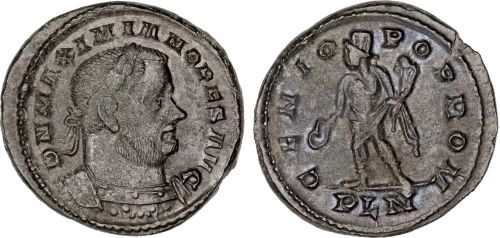
Maximianus’ reluctance to retire, or at least his disagreement with the idle life, soon revealed itself. When his son Maxentius raised a revolt in Rome in AD 306, Maximianus at once came out of retirement to support him, luring away the troops under Severus. Maximianus fell out with his son, however, and went over to his son-in-law Constantine (see Figure 10, a follis of Maximianus issued by Constantine during the former’s short second reign). An emergency meeting of the Tetrarchy at Carnuntum in AD 308 brought Diocletian out of retirement from his palace at Split. Once again, he persuaded Maximianus to retire again and an agreement for Constantine and Maxentius was also arranged. Maximianus acquiesced to his former colleague, but not for long. While Constantine was away sorting out a barbarian invasion on the Rhine, Maximianus again rose up in revolt. Constantine’s forces remained loyal however and Maximianus was imprisoned and died in captivity. Whether by suicide as it was officially declared, or by being quietly and deliberately removed.
Diocletian was unquestionably responsible for the success of the first tetrarchy – his personality and policy were key to bringing stability and an end to the “Third Century Crisis”. Some credit, however, also lies with Maximianus. Without his steady loyalty, the Tetrarchy would have been an interesting but failed experiment. If Maximianus had displayed the same disloyalty as he revealed under his own son Maxentius and then his son-in-law Constantine, Diocletian would probably have been doomed, and the third century crisis could have extended into the fourth century. Maximianus demonstrated that he was not intrinsically a loyal person, so the credit must go to the dynamic between the two men, who certainly had an unusual but good working relationship.
Such a great city to visit! Blister patches and replacement inner socks easily found – bliss. We once again strolled through the magnificent train station building, gazing upwards in awe at the amazing architecture. Packed with people, we then spent an hour on the train to return to Fidenza before dining on some delicious seafood pasta – then back to the pilgrim path for us!
As the Second Tetrarchy dissolved into a dyarchy between Constantine and Licinius, and then the sole rule of Constantine, Mediolanum lapsed back to being an important city but no longer one of the capitals. It was here in AD 313 that Constantine and Licinius jointly published the Edict of Milan, granting toleration to all religions within the Roman Empire and ending official persecution of Christianity. Both Emperors were in Milan at that time to celebrate a wedding: the marriage between Licinius and Constantine’s half-sister, Constantia.
Under Valentinian (AD 364-375), who made Mediolanum his capital, a mint once again became operational, issuing coins for the first time since the reign of Aurelian. First gold solidi and then silver siliquae were struck here, frequently with the mintmark “MD”. It remained a capital throughout the reigns of Valentinian’s sons Gratian (AD 367-383) and Valentinian II (AD 375-392), but Milan also came under the stewardship of Bishop Ambrose (who became St Ambrose). His dogged leadership (he was a strong opponent of Arianism) brought Christianity and the Church to further prominence in the West. In AD 390 the Emperor Theodosius had to make public penance at the behest of the bishop of Mediolanum for atrocities performed by imperial troops on the citizens of Thessalonica. When Theodosius died at Milan in AD 394, it was Ambrose who gave the oration at his funeral.
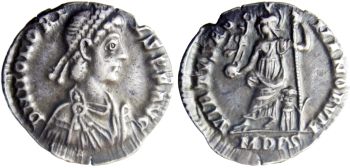
Theodosius’ son Honorius, ruling in the West, moved the capital to Ravenna after Alaric the Goth invaded Italy in AD 401 (see Figure 11, a silver siliqua of Honorius issued from Milan). Ravenna, near the mouth of the Po, was defended by marshes and could be easily accessed from the sea. It remained the capital until the end of the Western Roman Empire. Milan was besieged by Visigoths, then Huns and then destroyed by the Ostrogoths during Justinian’s reconquest of Italy (AD 539). Mediolanum, now Milan, only remerged to prominence during the Late Middle Ages and the Renaissance, under the Visconti family and then the Sforza.
That concludes our series of articles following in the footsteps of Sigeric and exploring ancient sites en route. We have especially enjoyed our visits to Roman mint cities, and the food of course.
This article has appeared in Australian Coin Review magazine, May 2024.