
Lyon (or Lyons) is the third largest city in France and lies on the confluence of the Rhone and Saone rivers. It was equally important in Ancient times, being Lugdunum, the largest city in Gaul (after Narbo) for the first and second century AD. Many Roman ruins are still evident today in the modern city but no evidence remains of its mint, which produced some of the most recognisable coins of the early Julio Claudian period. Lyons is not on the Via Francigena but is closest to it at Besançon. It was too good an opportunity to miss, so when we arrived in Besançon a few days ahead of schedule, we took some time out for a little excursion.
On our road to Rome, we took a sidestep (train) to Paris and Lyons. We had a much anticipated appointment at the Bibliothèque nationale de France (BnF) and we greatly desired to view the site of the Roman mint of Lugdunum. European trains are sooo exciting! Fast, efficient and regular. With a minimum of fuss, we viewed ancient coins in Paris and then spent a day walking around and enjoying Lyons before returning to our walk.
We’d already taken a bit of a break at Besançon, visiting friends and spending a few days in the nearby countryside - enjoying swimming in the river and a French BBQ. Paris too was hot, swarms of people and endless lines at the entrances to attractions. Luckily, we had an appointment at the BnF and were whisked into the bowels of the building to view tray after tray of delicious coins. The staff were super helpful and friendly, bringing out multiple trays of Cappadocian coins. We were fortunate to study some unique and rare examples.
After a couple of superb meals at our new favourite restaurant, Le Petit George, we jumped on the train to Lyons, eager to see the site of Rome’s main gold and silver mint.
The importance of Lugdunum (Lyons) as a site is best summed up by Sutherland in Roman Imperial Coinage Volume I: “Lying in a magnificent position on the confluence of the Rhone and the Saone, and thus dominating the highly Romanized area of Provence and lying adjacent to the Alps and the headwaters of the Rhine, Lugdunum was founded as a colony (Colonia Copia Felix Munatia) in 43 BC.” Since the second century BC, Rome had controlled the southern coast of Gaul, then known as Gallis Provincia (which became known as Provence). After Julius Caesar had conquered the rest of Gaul (58-50 BC), Roman control was extended. Archaeological evidence points to a thriving Celtic settlement at Lyons for centuries before the Roman colony was founded. In the turmoil after Caesar’s assassination, the Senate found itself at odds with Marc Antony, Caesar’s former lieutenant. According to Dio (54.) they were afraid that Roman veterans in Gaul might march south to augment Antony’s forces besieging Mutina and they ordered Lepidus (Marcus Aemilius Lepidus, another former lieutenant of Caesar and successor of Caesar as Pontifex Maximus) and Lucius Plancus (Lucius Munatio Plancus) to found a colony for these veterans. Both men were responsible for administering different areas of the recently enlarged Roman Gaul.
Although formally known as Colonia Copia Felix Munatia, it quickly became known as Lugdunum, a romanisation of the Celtic words for a fortress in honour of Lugh, who was an important Celtic god. Over the centuries into the modern era this became “Lyon” in French. Under Augustus, Gaul was organised into four provinces: Gallia Narbonensis (most of the former Gallia Provincia), Gallia Lugdunensis (Central Gaul extending to Armorica), Aquitania (roughly the same area as modern Aquitaine on the west coast) and Belgica (roughly the same area as modern Belgium). As is apparent from the name, Lugdunum was the capital for Gallia Lugdunensis.
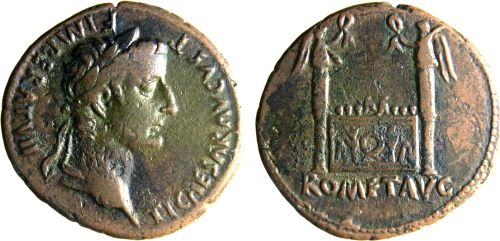
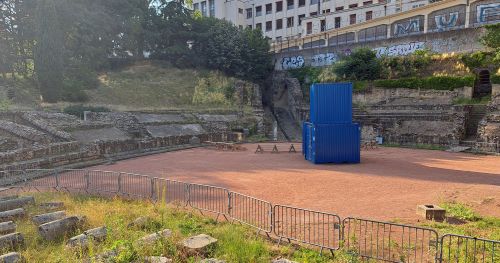
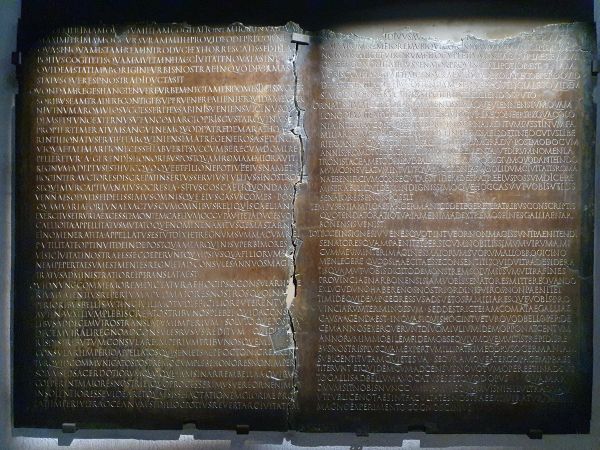
The city was further augmented under Augustus. Not only was it the capital of a province but it also became the most important mint of Roman Imperial coinage for the early Julio Claudian period. An aqueduct was constructed in 20 BC to bring fresh water to the new city – three others were later added as the city grew. It also became the site for the Gallic Council that met annually after an Altar to Rome and Augustus was founded there in 12 BC by Nero Drusus (illustrated on the reverse of a bronze as of Tiberius, see Figure 1). Drusus was the stepson of Augustus and also the father of the future emperor Claudius who was born at Lugdunum in 10 BC, during his father’s time there. The emperor Tiberius (who reigned AD 14-37 and was Nero Drusus’ brother and Augustus’ successor) continued his predecessor’s policy of enhancing the city and retaining it as a mint. The first amphitheatre in Gaul was constructed there early in his reign (see Figure 2 for the remains of the amphitheatre). The emperor Caligula visited the city and held spectacular games. According to Josephus ( Jewish Antiquities, 18.7.2) the same emperor later exiled Herod Antipas, the errant king of Judaea, to Lugdunum in AD 39 (although the same author in another work, Jewish War 2.9.6, claims he was banished into Spain). Caligula planned to spare his wife, Herodias (the same wife in the Gospel who used her dancing daughter Salome to encourage Herod Antipas to order the execution of John the Baptist). She refused his generosity, he grew angry and sent her into exile to join her husband. When Claudius became emperor (AD 41-54) he gave a speech in the Senate in favour of worthy Gauls being granted entry into the Roman Senate. This speech was inscribed in huge bronze plaques erected in Lugdunum and survives on display in the Roman museum there (see Figure 3).
During Vindex’s revolt against Nero in AD 68, most of Lugdunum stayed loyal to the emperor. Some of Vindex’s men were besieging the city when his revolt was crushed at Vesontio (Besançon, see our previous article on this). Lugdunum continued to prosper throughout the first and second century AD, although it only functioned irregularly as a mint city. In AD 195, however, Lugdunum became the site of the battle between the emperor Septimius Severus and his rival Clodius Albinus, who used the city as his base. The city was also plundered by the victorious forces of Severus and never recovered its former prosperity. In the third century it began regularly issuing coins as a mint city, but after Diocletian reorganised all the provinces of the Empire, it was no longer considered the “Capital of Gaul”. After the Western Roman Empire collapsed in the fifth century AD, the city became the capital of the Kingdom of the Burgundians.
What an amazing city! We arrived at the station, crossed a rather generic mall (quickly purchased some hiking shorts and tops) and found ourselves on the peninsular between the Rhone and the Saone surrounded by 4-6 storey buildings of a grand scale. Wide streets, multiple large, open squares and lots of pavement gave the city a rather genteel feel. Water features in the squares had children splashing and adults enjoying the spray. The river too is wide and open, crossed by long low bridges.
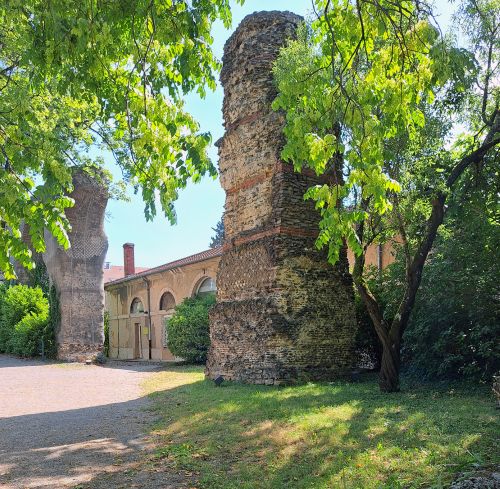
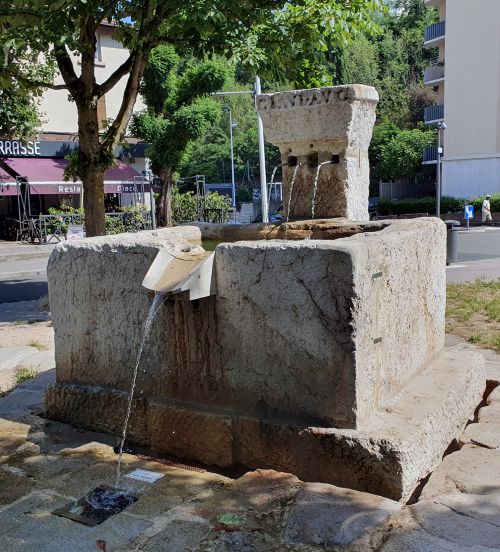
On the other side the hill rises steeply. It was a hot day, but it was exhilarating to climb up and explore the remains of Roman Lugdunum. The steep hill was full of pockets of ruins - a church, the thermal baths, a basilica (amazing views over the city), tombs, the aqueduct, an insula and theatres. We followed the Aqueduct (see Figure 4) through the city streets – apparently it is visible for a considerable distance beyond the city, but we needed our energy to resume the walk. As we roamed the streets we chanced upon an ancient Roman fountain with the inscription “CLAVD AVG” – it had been dedicated to the Emperor Claudius (see Figure 5). The park that holds the insula and two theatres is a huge open site. Both were restored enough to house modern productions, but the size and extent of the ruins were astounding (see Figure 6). We had lunch looking up at the Odeon and then visited the Lugdunum museum. It was especially rewarding, with huge mosaics (a thrill to walk on!), tons of inscriptions (including one of an early Timisetheus before he became Praetorian prefect under Gordian III, the Lyon Tablet – a speech by Claudius, see Figure 3) and busts (including Caracalla, who was born in Lugdunum).
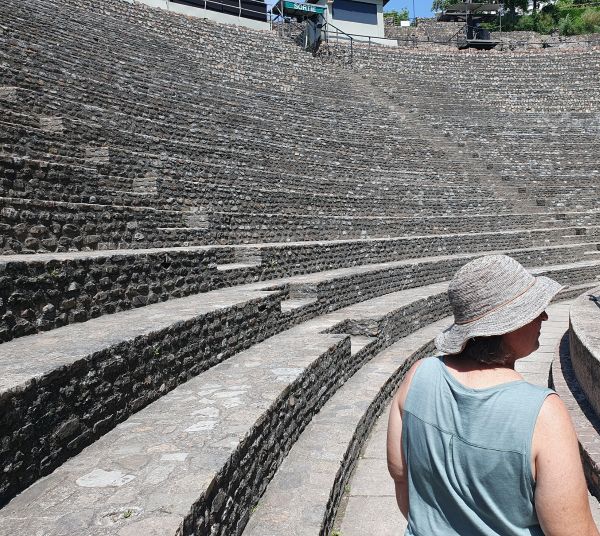
Somewhat sweaty, we crossed back to view the remains of the Amphitheatre of the Three Gauls (see Figure 2). It would have been fantastic to walk around but unfortunately it was closed off for an event in four days’ time - frustrating! We followed the stone-paved streets back to our funky accommodation hidden inside a Renaissance exterior, conveniently located on the peninsular between the two rivers.
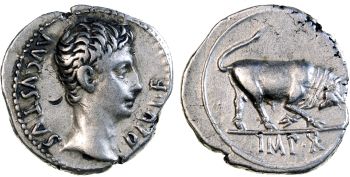
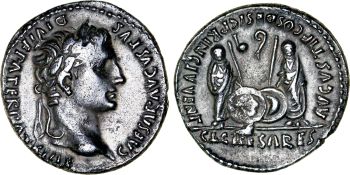
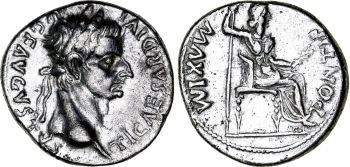
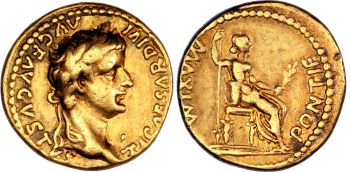
As noted, Lugdunum was an important mint city for a long time throughout the Roman Imperial period. During Augustus’ later years and the reign of Tiberius it was the premier Imperial mint issuing gold and silver. It was Augustus’ visit to Gaul around 16 BC when Lugdunum moved from being a colonial mint issuing bronze to an official Imperial mint. Gold aurei and silver denarii, such as the type with the butting bull reverse were issued with Augustus’ portrait and in his name from Lugdunum around this time (see Figure 7). It was also the mint that issued the Gaius and Lucius reverse denarii and aurei that were so common during Augustus’ later years (see Figure 8). Tiberius, faithfully following his stepfather’s policies, kept Lugdunum as the primary Imperial mint, as noted by Strabo (who wrote his Geographica during Tiberius’ reign): “the Roman emperors coin their money there, both the silver and the gold” (Strabo 4.3.2). The famous “Tribute Penny” denarius issued by Tiberius showing Pax (or Livia) seated on the reverse (see Figure 9) was issued from Lugdunum for most of Tiberius’ reign (see Figure 10 for the gold version of the same type, also issued at Lugdunum). Most numismatists believe that it was in the first years of Caligula’s reign that the issuing of gold and silver was moved back to Rome (although there are arguments to the contrary). Bronze was still issued from Lugdunum during the later reign of Nero. Silver and bronze were briefly issued early during Vespasian’s reign but then only irregular bronze issues to the time of Domitian. Rome remained the principle Western mint throughout the second century AD and it was only during the reign of Valerian in the third century that the mint of Lugdunum again started issuing coins, mainly silver antoninianii.
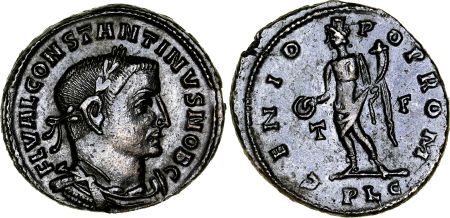
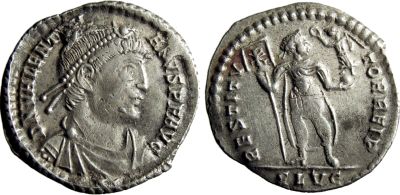
The mint was lost to Postumus’ revolt during the reign of Gallienus and sometime in the mid AD 260s Postumus moved the mint to Cologne. It moved back to Lugdunum during the last years of Tetricus’ reign and reverted to being an Imperial mint when Aurelian retook the Gallic provinces early in AD 274. Four officinae (workshops) were usual for Lugdunum throughout the rest of the third century. Lugdunum was confirmed as an Imperial mint during Diocletian’s mint reorganization in the AD 290s, but the third and fourth officinae were moved to Treveri (Trier), the base of Constantius, the tetrarch responsible for the Western provinces. Lugdunum under the tetrarchy only issued folles and mainly the GENIO POPVLARI ROMANI types (see Figure 11). The mintmark PLG was usual for Lugdunum for the remainder of the Roman Empire, although other variations were sometimes used. During the reigns of Constantius II and Constans, the sons of Constantine, gold and silver coins were once again issued from Lugdunum and thereafter were commonly issued until the reign of Honorius, when the mint ceased operation totally around AD 395 (see Figure 12, a siliqua of Valentinian I).
We polished off our visit with an armchair archaeological journey (Indiana Jones!) in a nice, cool cinema. We had enjoyed the large open streets of Lyons contrasting with the steep hilly climbs and quite amazing Roman ruins of Lugdunum. The museum is certainly one to recommend.
After a refreshing few days visiting friends, viewing a plethora of coins and enjoying the ruins of Lugdunum, we resumed our road to Rome. We had laughed, explored and feasted. France delivered – tres bon!
This article has appeared in Australian Coin Review magazine, March 2024.