
In its 500 years and more as the capital of the world, there were many marches on Ancient Rome. While some, like Hannibal, have been foreign armies, most have been Romans themselves. Sulla was the first Roman to march on Rome and seize power in 88 BC, but not all marches on the capital ended in a battle – sometimes merely the threat was enough. Julius Caesar crossed the Rubicon in 49 BC and Pompey capitulated, retreating from Italy altogether. Caesar’s nephew Octavian marched on Rome in 44 BC at the age of only 19 and the threat was enough for the Senate to recognise him. Galba marched from Spain in AD 68 only to find that Nero had committed suicide. There is one march, however, that we will be echoing in our walk south across Italy – that of Constantine in AD 312. We also hope that, like Constantine, our march will be culminating on the 28 th October but hopefully not with a battle at the Milvian bridge.
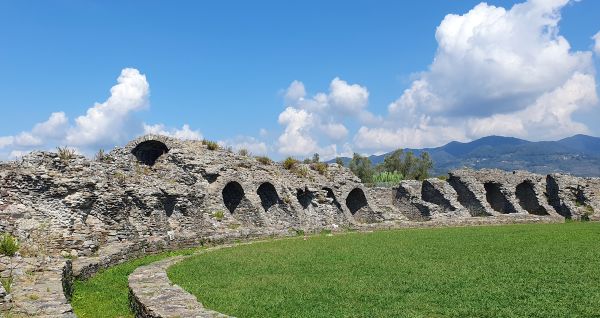
The Apennines behind us, we continue towards Rome. We descend towards the sea and walk along streets lined with marble (called “Lunense” by the Romans) pavements, gutters and street furniture. We gaze upwards towards Carrara and the quarried white hills as we discover Luni and its excavated amphitheatre, forum, domus, frescoes and mosaics (see Figure 1). We are heady with the mix of Roman and Etruscan history.
After the brief coastal stretch, we head up amongst the hills again and are delighted to stay in a renovated olive oil press. The food is excellent and the weather idyllic. Pencil pines and cypresses top the rolling hills of Tuscany and our minds wander forwards towards the eternal city and its seven hills. Our march across southern England, France, Switzerland and northern Italy has been directed towards this moment, the descent to Roma.
When Diocletian reorganised the structure of the Empire under the Tetrarchy in the AD 290s, the prominence of Rome as a city began to dwindle. At first the empire was informally split East and West between two emperors (Augusti) – Diocletian based at Nicomedia and his colleague Maximianus, based at Milan. Later each Augustus was supported by a Caesar – Constantius in the West based at Trier and Galerius in the East based at Thessalonica. These four, the Tetrarchs, cooperated to rule the Empire jointly, each tied with marriages. Constantius was married to Maximianus’ stepdaughter Theodora, Galerius was married to Diocletian’s daughter Galeria Valeria. In AD 305 Diocletian and Maximianus retired – each of their “juniors” succeeded them – Constantius became August of the West, Galerius Augustus of the East. Two new Caesars were appointed. Although Maximianus and Constantius both had adult sons (Maxentius and Constantine respectively) they were passed over in favour of two newcomers – Severus, a companion of Galerius, and Maximinus, Galerius’ nephew. The discontent of Constantine and Maxentius was to soon destroy the harmony of the Tetrarchy, which had helped ensure the past twenty years of stable rule.
Six months of walking, seeking accommodations, sourcing sustenance and hours of discourse have served to strengthen our bond and (amazingly!) we are still talking and enjoying our journey. Together we have followed in the wake of other pilgrims, on our own unique adventure. Each morning we check the path ahead, prepare our food and water options, then walk on 15-20km, rest and rejuvenate. We are looking towards the culmination of our journey with light hearts.
Lucca is a beautiful city, a popular starting point for pilgrims seeking a shorter walk along the Via Francigena to Rome. Surrounded by its Renaissance walls, great for promenading even today, with the site of its amphitheatre preserved in the shape of Piazza dell’Anfiteatro.
We walk on, climbing to the hilltop towns of Fucecchio, San Miniato, Gambassi Terme, San Gimignano, Colle di Val d’Elsa and Monteriggioni. All take my breath away - beautiful views, fantastic food but many tourists and more pilgrims than we have seen on the entire journey! The Etruscan terme at Colle di Val d’Elsa is well worth a dip and we delight in finding a deserted Etruscan necropolis nearby.
Constantine, who was kept as a hostage at the court of Galerius, fled Nicomedia to join his father Constantius on campaign in Britain. When Constantius died in AD 306, the legions at Eboracum (York) proclaimed Constantine emperor. This bucked the promotion system of the Tetrarchy, which saw Severus become Constantius’ replacement as Augustus of the West. The senior Augustus, Galerius, chose another old companion, Licinius, to be Severus’ new Caesar. On the 28 th October AD 306, Maxentius, Maximianus’ son who was at Rome, also proclaimed himself emperor. Maximianus soon came out of retirement to support his son. Severus marched on Maxentius but was killed en route. A hasty conference was called at Carnutum (Diocletian was brought out of retirement) to preserve the Tetrarchy. The outcome was that Diocletian and Maximianus retired again and Constantine and Maxentius were given the title ‘Filius Augustorum’ (sons of the Augusti). Constantine and Maxentius were still dissatisfied. Maximianus quarrelled with his son and joined Constantine (who had married his daughter Fausta). While Constantine was dealing with incursions on the frontier in 310, Maximianus proclaimed himself emperor for the third time. He was quickly captured and either committed suicide or was quietly executed. Maxentius objected to his father’s treatment, and a state of war existed between Constantine in Trier and Maxentius in Rome.
We have been surprisingly lucky! The weather has been near perfect for walking with little rain and we have been forewarned of diversions, tricky paths and obscure signage. The scenery has been magnificent and everchanging. As we walk through the Tuscan hills, along ridges and up into the imposing hilltop towns we are touched gently by the particular light and sunshine that contrasts so strongly with the harsh sun of our homeland.
We find ourselves surrounded by she-wolf images in Siena. According to legend, Remus’ sons Senius and Aschius founded the city after escaping the wrath of their uncle Romulus. Apparently, these young wags stole the statue of the Capitoline Wolf from the Temple of Apollo on their way out of Rome.
The sounds of drumming echo and flags wave as the districts of Siena celebrate each afternoon/evening during our visit. They march around the streets and whip up an extra frenzy as they enter the main square. We are blown away by the Etruscan and Roman finds housed opposite the Duomo in Santa Maria della Scala. One of the oldest hospitals in Europe, it is filled with tunnels, excavations, artefacts and coins.
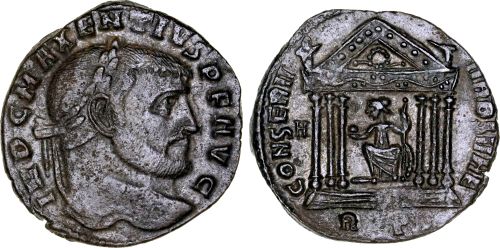
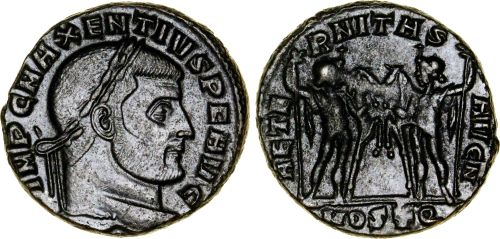
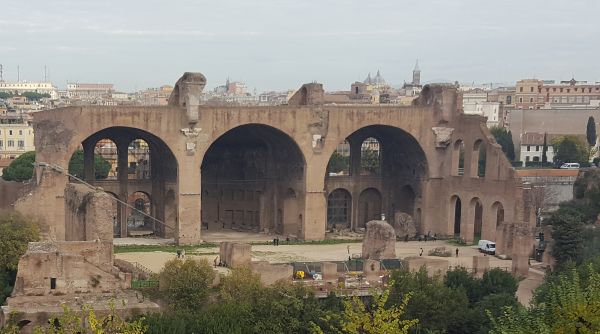
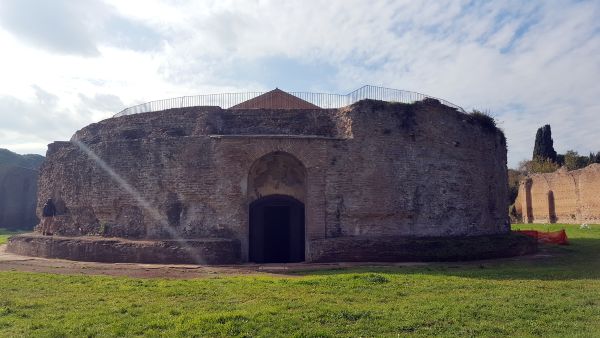
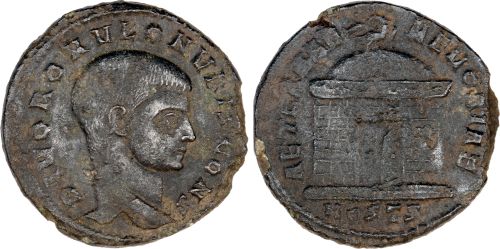
The accounts of Maxentius’ reign were all written well after Constantine’s domination and are universally hostile to him. Maxentius, however, seems to have garnered strong support in Rome – both had been passed over by the Tetrarchy. All the tetrarchs issued coins and, by controlling Italy and Africa, Maxentius had custody of four mints: Aquileia, Ticinum, Rome and Carthage. To this he added a fifth: a new mint at Ostia. Maxentius’ reverse types celebrated particularly Roman themes: Roma seated within a temple (see Figure 2) and the Dioscuri with their horses (see Figure 3) being two very common types issued on the bronze folles. Maxentius had also embarked on a building program in the old capital that had been neglected for the past twenty years. A magnificent basilica was started in the forum (see Figure 4) and a stadium was built just outside the walls. Maxentius had a young son whose name Romulus also echoed his Rome-centric policies, but the lad died young and a large mausoleum for him (see Figure 5) was constructed on the Via Appia near the new stadium. The mausoleum and portrait of the deified Romulus was also issued on coin (see Figure 6).
We have a particularly exciting day when, after swimming in the thermal baths at Bagno Vignoni, we encounter a number of wild boars running across the path in front of us. An adult at each end, there were about nine in the line. Perhaps they were fleeing from us, we had not encountered many hunters that day.
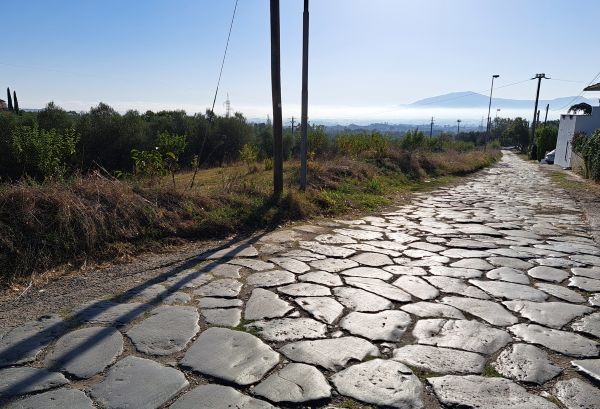
At Radicofani we enjoy one of our last Tuscan sunsets, the evenings are getting a little cool as we head toward Lazio. We follow the Via Cassia, sometimes the Via Cassia Antica! (see Figure 7), as we creep closer to Rome.
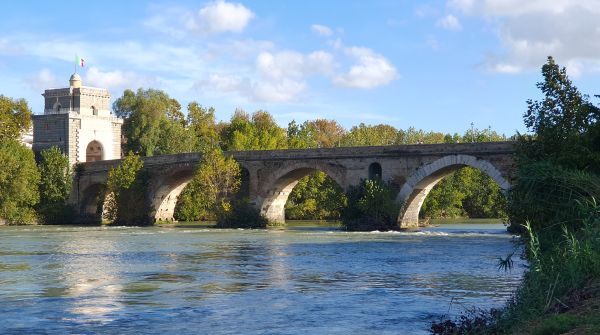
Constantine, in preparation for his war with Maxentius, came to an agreement with Licinius, another Tetrarch. Constantine’s sister Constantia was betrothed to Licinius and their pact meant each could concentrate on facing their rivals: Constantine against Maxentius, Licinius against Maximinus. Early in 312 Constantine marched down Italy, defeating Maxentius’ forces in two battles on his way to Rome. Maxentius had decided to throw his remaining forces at Constantine just before Rome, defending the Milvian Bridge on the Via Flaminia. This bridge across the Tiber was first built in 206 BC and then rebuilt in stone in 106 BC by the Censor M. Aemilius Scaurus (see Figure 8).
Just before Bolsena we find the ruins of Volsinii – a wonderful site with an excavated forum, public buildings, baths and houses. We roam around the mosaics, descend to the ice cave, and enjoy the views to Lake Bolsena. The nearby museum housed in an old tower holds a great collection.
We spend a few days swimming in the clear and placid lake, mustering our energy for the final march towards Rome.
Constantine marched down the Via Flaminia towards Rome. Our “march” takes us down the Via Cassia. The Via Flaminia was built around 220 BC by the Censor Gaius Flaminius and ran directly north of Rome to Ariminum (modern Rimini) and the Adriatic coast. The Via Cassia, however, was probably built in the second century BC by a Cassius Longinus, an ancestor of the Cassius that assassinated Caesar in 44 BC. It ran Northwest from Rome through Etruria (modern Tuscany) to Luna on the coast. Sections of this ancient Roman road still remain intact (see Figure 7).
The forces of Constantine and Maxentius faced each other in the famous Battle of the Milvian Bridge on the 28 th October 312. The previous night, so the Christian tradition relates, Constantine had his famous dream or vision that led to the eventual conversion of the Roman Empire to Christianity.
I love walking along the deep Cav és, the ancient sunken roads, connecting us to the Etruscans and those who walked here before us. Both the ancient termes and the modern thermal baths are balm for the tired pilgrim body and soul.
I am soooo excited to enter the Roman Mithraeum at Sutri! It is a dark and mysterious place and we are allowed only 7 minutes inside, perhaps to protect /preserve the frescoes. A church has been imposed over the top, and the Villa Savorelli sits above with its Italian garden and woods. This giant lump of tufa is an amazing site, the necropolis is built into the rock all around the hill and the Roman amphitheatre has been carved out of the tufa – the only one of its kind.
By the third century AD, mystery cults had become popular across the empire and the old pagan Roman pantheon was on the decline. Some earlier emperors, such as Elagabalus and Aurelian, had seen unifying elements in some of these cults, namely Sol Invictus, as beneficial to the Empire and tried to promote a syncretic religion. The worship of another mystery solar cult, Mithras, was also popular, particularly within the army. Many Romans saw Christianity as just another fringe mystery cult, albeit one that denied all the others and all other pagan worship. Stringent attempts had been made by previous emperors, including the Tetrarchy, to persecute and execute Christians, but the cult had persevered. On the eve of the Battle of the Milvian Bridge, Constantine either had a vision or a dream (accounts differ) of either a Christogram (a monogram of the Greek letters Chi [X] and Rho [P]) or a staurogram (Latin cross with rounded P top) with the words “By this sign conquer”. Constantine’s soldiers were ordered to paint this symbol upon their shields before the battle.
Isola Farnese is our final hilltop village before Rome. We stay in a room in the Farnese Castle and with a day to spare explore the Parco Veio. We wander this former Etruscan stronghold, littered with tombs and an amazing irrigation tunnel. I see a solo wild boar through the tunnel, crossing the stream…
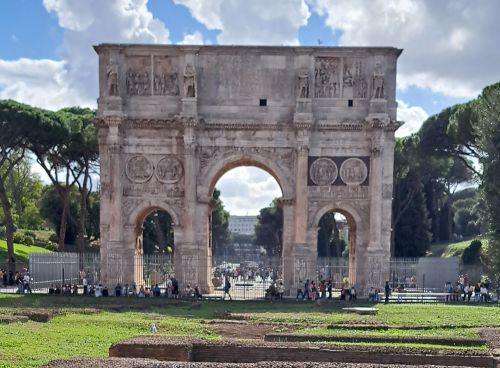
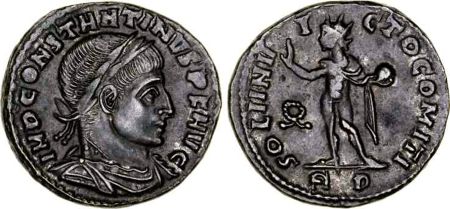
According to the accounts, Maxentius had rigged or altered the Milvian Bridge to deny Constantine’s crossing but it collapsed during the battle and Maxentius drowned in the Tiber. His body was recovered and his head sent on to Rome and later to Carthage (Africa had stayed loyal to Maxentius). Constantine marched into Rome victorious and the famous Arch of Constantine was later erected to commemorate his victory (see Figure 9). Some of Maxentius’s building works were appropriated by Constantine and to this day the Basilica of Maxentius is sometimes labelled as the Basilica of Constantine. Constantine was undisputed master of the West and, a year later his colleague Licinius defeated Maximinus and ruled the East. The persecution of the Christians ended and much property and protections were given to the Church. Whether Constanine himself became wholly Christian is debatable. Sol Invictus, for example, continued to be celebrated on his coinage well after the Battle of the Milvian Bridge (see Figure 10). Eventually Constantine defeated Licinius and became sole Emperor of the Roman World, and a new capital was founded at Byzantium, now called Constantinople. Rome’s brief resurgence under Maxentius was over.
After nearly six months our bodies are fit, walking has become easy and our boots are wearing thin. We slow our march and lurk on the outskirts of Rome on the eve of Matthew’s birthday.
Before our final march on Rome, we dine in style in an old mill. The busy Via Cassia awaits us with our final stop at the so-called Tomb of Nero. We have roughly followed the Via Cassia since Siena, often walking over exposed sections of the ancient road. Its straight line has helped give us direction and a lasting ancient connection to the Romans who built the original.
We walk into Rome on the 28 th October, the anniversary of this great battle and my 50 th Birthday. We left Canterbury on the 1 st May and have walked for almost six months, following roughly the path set down in Sigeric’s itinerary when he came to Rome from Canterbury to receive the pallium of his archbishopric from the Pope in AD 990. The 28 th October, however, is also the anniversary of Sigeric’s death. He died in AD 994 in Canterbury, having been Archbishop for only four years and spending a quarter of that time journeying to and from Rome.
All along our path from Britain to Rome (and in our articles) we have constantly observed references to Julius Caesar, who we feel we have been pushing against. Over the period of his first consulship and pro-consulship, Caesar started in Rome, moved north into Cisalpine Gaul, crossed the Alps, conquered Gaul and then flitted across briefly to South East Britain - the opposite of the direction we have been taking. But in reality we have been mirroring Constantine’s early rise. Constantine was proclaimed Emperor in Britain, crossed into Gaul to consolidate power and then crossed the Alps and marched on Rome to face Maxentius. Constantine paved the way for Christianity to prevail in Europe over the Middle Ages. Rome remained as a city of prime significance after the Empire fell (the Eternal City) and hence an object of Pilgrimage.
Our final walk through the streets of Rome is relatively peaceful, it is a Saturday morning. We descend towards the Tiber and cross the Milvian Bridge without incident. As before, I’m surprised by how fast the water flows. We cross back over a more flashy modern pedestrian bridge and enter the Vatican – our final country on this journey. As pilgrims, we take the fast lane through Vatican security and avoid the enormous queues of mere tourists. Bliss! We receive our Testimoniums and take a few happy snaps (see Figure 11).
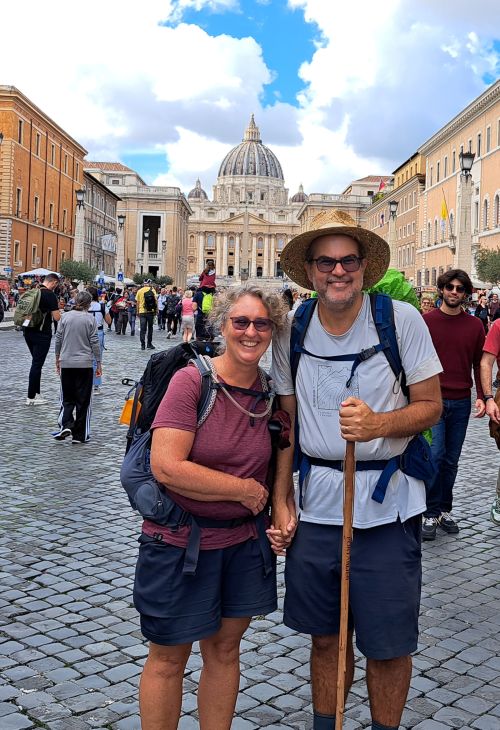
We’ve done it! Six months of walking, following in the steps of Sigeric along the Via Francigena from Canterbury to Rome. Unlike Sigeric though, we will fly back!
As a final note for the entire article series, we would like to thank our readers for persevering along our rather self-indulgent journey. There are doubtless many errors I have made throughout the series, being separated from my library and having to rely on my memory, notes and the often-untrustworthy online resources. We felt, however, that it was more important to write these articles as we walked rather than produce a monumental academic but perhaps more accurate endeavour.
This article has appeared in Australian Coin Review magazine, December 2023.