
The Italian Alps end abruptly at a wide flat plain fed by the mighty Po river. This land is still called Lombardy from the German tribe that settled here in the sixth century AD. The ancient capital of the Lombards was the city of Pavia, set in the middle of the plains on the banks of the Ticino, a tributary of the Po. The Romans founded a settlement here that was called Ticinum. In the late third century AD this settlement became an important Imperial mint, issuing gold and silvered bronze coins.
On our way out of Ivrea we pause for a photo with a giant cutout of Sigeric, the man behind the pilgrim stops we are emulating. It is right on 8am and the Infostop is just opening as they take our photo for their Instagram page. We need to get another Pilgrim Passport, the document that shows our journey and is filled with stamps from the places we have stayed. Churches, hostels, tourist offices and many accommodations have their own stamp which is reassuringly inked in the old way. We are running out of spaces as we near the two thirds mark of our journey.
Ahead is a twenty kilometre walk to Viverone where we hope to swim in the lake, but finding it very shallow we settle for just getting wet. It is hot. We are having some difficulties finding accommodation just where we want it so our stages are a bit erratic in length. The heat is ramping up and we are sweating within the first half hour. It is only mid 30s, but the temperature is getting too high for walking.
The path is now fairly flat, and after Santhia we head across the Po valley and weave our way through rice and corn fields. This is the home of arborio rice and we enjoy some cold rice salads as we contemplate the simple but effective paddies and their drainage system. Whilst the land appears flat as far as the eye can see, it is very slightly sloping and the fields each step down a little as we head south.
Mozzies are our main threat fauna-wise, our early starts mean they are still about and I madly swat at them as I look forward to the sun which will drive them back into the rice plants. Then the heat and humidity get too much and we long for the two or three trees in the next 5km that are our only shade.
Before the Romans, according to Livy, a Ligurian settlement on the Ticino predated Ticinum. During the Second Punic War, Scipio built and defended a military bridge across the river as a defence of Italy against Hannibal’s invasion from the Alps. Although Scipio was defeated (as outlined in our previous article), the military encampment survived and became Ticinum. The town’s position on the river and the network of Roman roads assisted it’s growth but it achieved no major importance until the third century AD. In 271 a German tribe called the Juthungi invaded Italy and defeated the Emperor Aurelian at Placentia (modern Piacenza), however the Emperor was quick to recover and forced them to battle again at Ticinum, where he soundly defeated them. Not long after this, Aurelian opened a Roman mint there.
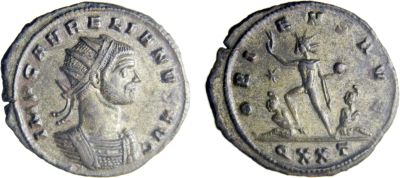
At various times the mint at Rome was supported by secondary mints out in the provinces that issued official Roman denominations. In the first century AD the mint of Lugdunum rivalled the issues from the official mint at Rome. By the early third century, the main mints were at Rome and Antioch with a minor mint at Viminacium in Moesia (Balkans). The Emperor Valerian moved the Viminacium mint to a more central position at Milan, and it opened in AD 255 or 256 with three officinae (workshops). This was later increased to four. By AD 275 Aurelian had recognised the advantages of Ticinum, doubtlessly due to the recent battle he had won there, and moved the mint at Milan to the banks of the Ticino where it had five officinae producing coins (this was later increased to six). Figure 1 is of an antoninianus of Aurelian from the fourth officinae or workshop (Q). The mint marks on the reverse of the coins issued from Ticinum were always in Latin (Eastern mints usually used Greek letters) and either T or TI. Until the reign of Diocletian, the mint at Ticinum issued gold aurei but mainly the silvered bronze antoninianii. Mattingly, in ‘Roman Imperial Coinage’ (RIC), describes Ticinum’s output as “considerable” but less than that of Rome and Siscia.
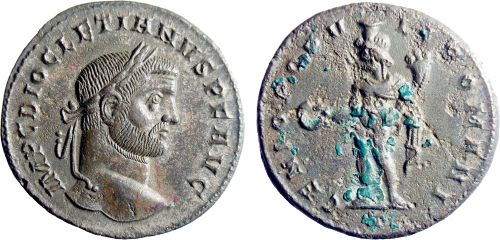
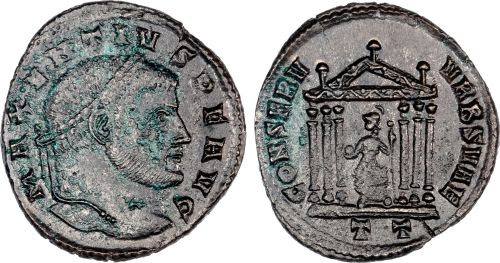
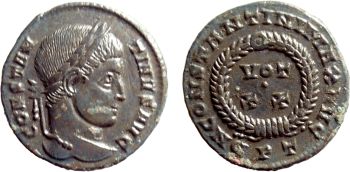
When Diocletian reorganised the mint system in the AD 290s, some mints were closed or consolidated and others converted from issuing provincial coins to issuing official Roman coins (such as Alexandria). The mint at Ticinum, however, continued, but its gold and silver issues were rare, it mainly produced the large silvered folles (see Figure 2). When Maxentius seized Italy in spite of Diocletian’s Tetrarchy, Ticinum started producing folles in his name (see Figure 3). The mint of Ticinum was still issuing coins in the reign of Constantine (see Figure 4) but ceased operation in AD 326 when its offices were moved to the mint at the new capital of Constantinople.
An elegant city, Pavia is entered via a covered bridge across the Ticino. Halfway across is a sanctified shrine. We walk along cobbled streets over the top of the original walls. We pass the remains of gatehouses/gates and the few remaining medieval towers built to wow the citizenry. Suitably impressed, we spend a couple of days here.
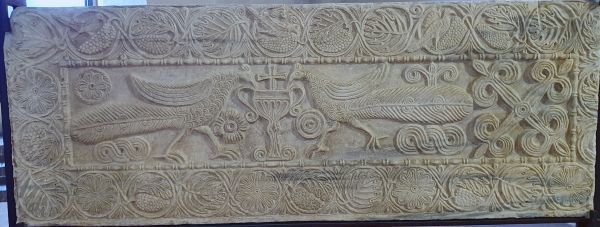
Catching up with friends met on the path, we enjoy the big squares surrounded by cafes and restaurants - first for mid-morning coffees and later for drinks. In between, we seek refuge from the sun in a museum housed in the Visconti Castle. The collection is accessed via long colonnades and includes many local finds from Ticinum - Roman glass, late Roman jewellery and Paleo Christian silver. The Longobard Room is a treasure trove, including two beautifully carved stone plaques (see Figure 5). There are also finds from a Celtic necropolis we will pass near in the days to come at Santa Christina e Bissone.
Continuing to escape the heat, we head down into the crypt of San Pietro and visit the tombs of King Luitprand, Boethius and Saint Augustine of Hippo.
During the later Empire, Ticinum was eclipsed first by Milan and then by Ravenna, which the Emperor Honorius made his capital. During the reign of the last emperor, Romulus Augustulus (AD 475-6), his father Orestes (the real power behind the reign) was defeated by Odoacer at a battle at Ticinum and executed. Romulus was deposed but allowed to live – Odoacer sent the Western Imperial regalia to the Emperor of the East, Leo, and the Western Roman Empire ceased to be. Zeno, next Eastern Roman Emperor, had issues with Odoacer, the new “king” of Italy. He sent Theodoric and his Ostrogoths into Italy in 489 and they defeated Odoacer. Theodoric’s heirs later made Ticinum the capital of Ostrogothic Italy, but the Byzantine Emperor Justinian strove to exploit instability after the death of Theodoric the Great. From 535 to 553 there was almost continual war between the Byzantine forces of Belisaurus and the Goths as Italy was slowly “reconquered”. In the end, the Byzantine forces were led by a eunuch called Narses who completed the subjugation of the Ostrogoths.
The Byzantine Reconquest did not last long. Italy was exhausted by the long war and Justinian’s successor, his nephew Justin II, recalled Narses from his command. In a fit of pique Narses reportedly invited the German tribe of the Langobards into Italy. The Langobards, later known as Lombards, originally inhabited northern Germany near the mouth of the Elbe and were mentioned by earlier Roman authors such as Strabo and Tacitus. During the migrations at the end of the Roman Empire, the tribe had moved south to occupy lands just north of the Alps. Led by King Alboin they invaded Italy and by 569 had conquered most of the North. Later kings expanded south past Rome and pushed Byzantine territory to only the “foot” of Italy. Ticinum became the capital of the Lombard kingdom and its name became Pavia, as it is known today.
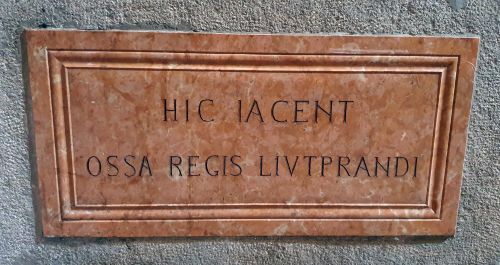
Throughout their rule over Italy, the Lombard Kings failed to implement any secure dynastic succession. Many kings were subsequently ousted and replaced by the powerful Lombard “Dukes”. The first kings were pagans, but converted to Arianism under King Agilulf (590-616). Many of the subsequent kings switched between Arianism and Catholicism, the former often putting themselves at odds with the Church in Italy. Finally, King Perctarit (661-688) made Catholicism official across his realm. The earliest coinage of the Lombards mimics the types of the Byzantine Empire which were issued in Italy previously (and continued to be issued in those parts of Italy still under the rule of Constantinople). King Perctarit’s son, Cunipert (688-700) was the first king to put his name and likeness on the gold coins issued by the Lombards. The Lombards only issued gold coins, mainly tremisses. One of the last kings of the Lombards, Luitprand (712-744), came to an agreement with the Pope, donating the lands around Sutri to the Papacy, which laid the ground for the future Papal States (his resting place is still extant in San Pietro in Ciel d'Oro in Pavia, see Figure 6). Luitprand was succeeded by his nephew Hildebrand (known as the “Useless”) who reigned only a few months before he was overthrow by Duke Ratchis. Ratchis was deposed in 749 and replaced by his brother Aistulf, who demanded tribute from the Papal States. Pope Stephen called in Pepin the Short, who he had made King of the Franks, and the Lombards were defeated after Pavia was beseiged. Aistulf was eventually replaced by Desiderius in 756. Although Desiderius initially had the support of King Pepin and the Pope, the Lombard King came into conflict with the new Pope Hadrian, who called upon the Papal alliance with the Franks. Pepin’s son Charlemagne, now King of the Franks and married to Desiderius’ daughter, responded and marched over the Alps to finally conquer the Lombard kingdom. Pavia and Desiderius were captured, the King was exiled to a monastery, and Charlemagne took the title ‘rex langobardorum’. In thanks for his many services, he was crowned Holy Roman Emperor by the Pope on Christmas Day 800. This initiative, as well as the Lombard donation of Sutri, led to the future struggles between the Holy Roman Emperor and the Papacy over the next centuries.
We exit Pavia via another bridge. Our path should, like Sigeric, take us across the Po by boat, but unfortunately the river is too low and so we take a bridge further downstream. It is hot but our path is elevated along flood levy walls and we catch the occasional hint of a breeze.
Piacenza is another grand city with cobbled streets and imposing civic buildings. There is an enormous covered market and large squares or piazzas filled with cafes. Salads are all we feel like in the continuing heat.
Crossing more fields we continue to see many Cassinas. Standing out on the plain, those to the south of the Po seem in better repair and inhabited, often as agriturismos like the one we stay in. This one is a beautiful collection of buildings and the family running it farm tomatoes for canning.
As always, the food of Italy doesn’t disappoint. As we head towards the Apennines we enjoy many different flavoured local sausages and dine on a tasty Donkey Stew at Cella following a chat with the chef. We walk past seemingly wild horses grazing at the very highest point, and my mind flicks back to the other options on the previous night’s menu – my conscious is clear!
This bit of the walk is tough, steep climbs and steep descents mostly on stoney paths which are hard on the feet. Hiking poles are quite often a hindrance, or at least slow me down. We see very few people and the small communities seem quite cut off, until we round a corner and happen upon another.
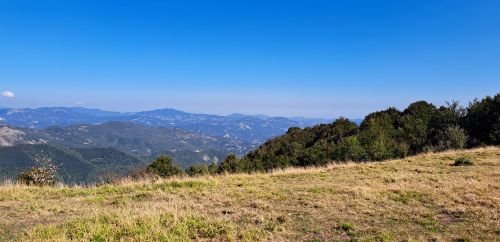
Onwards and upwards, the scenery (see Figure 7) is amazing as we climb to the Cisa Pass and cross into Tuscany.
This article has appeared in Australian Coin Review magazine, November 2023.